
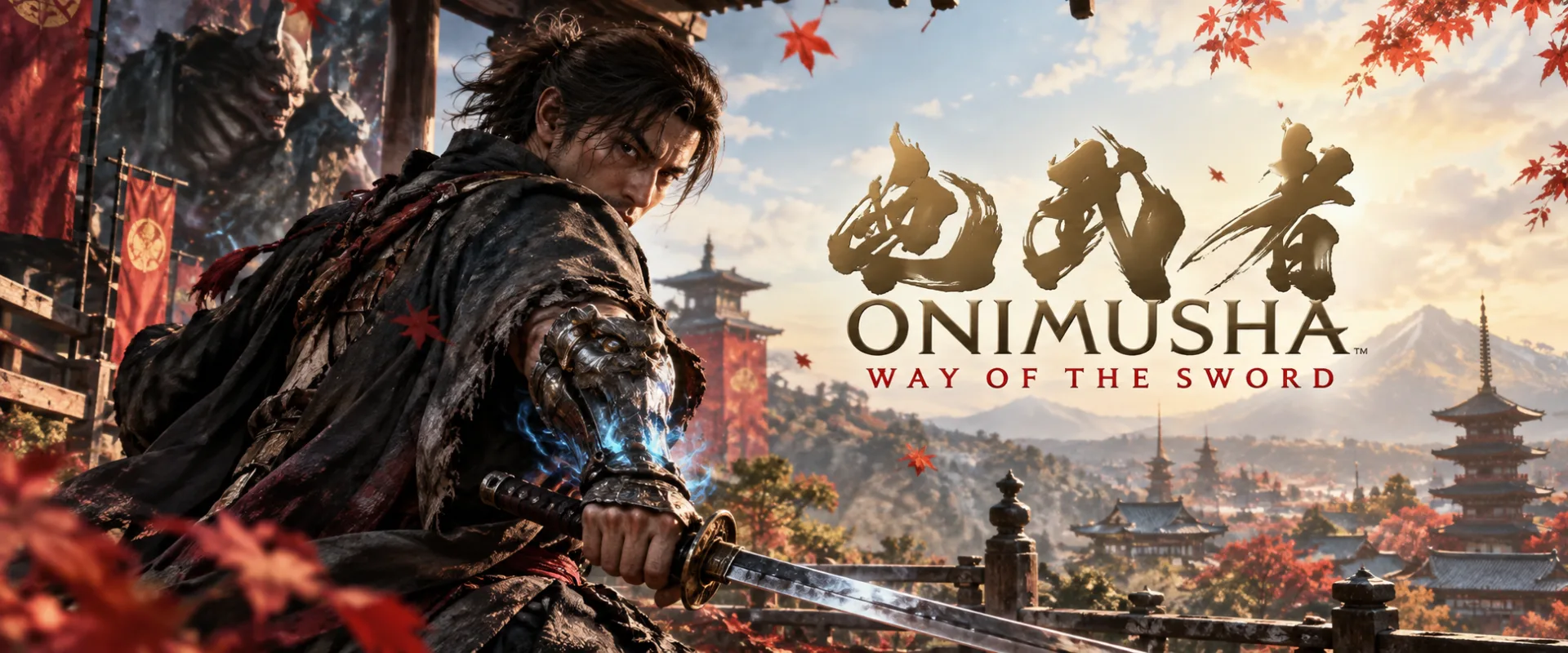
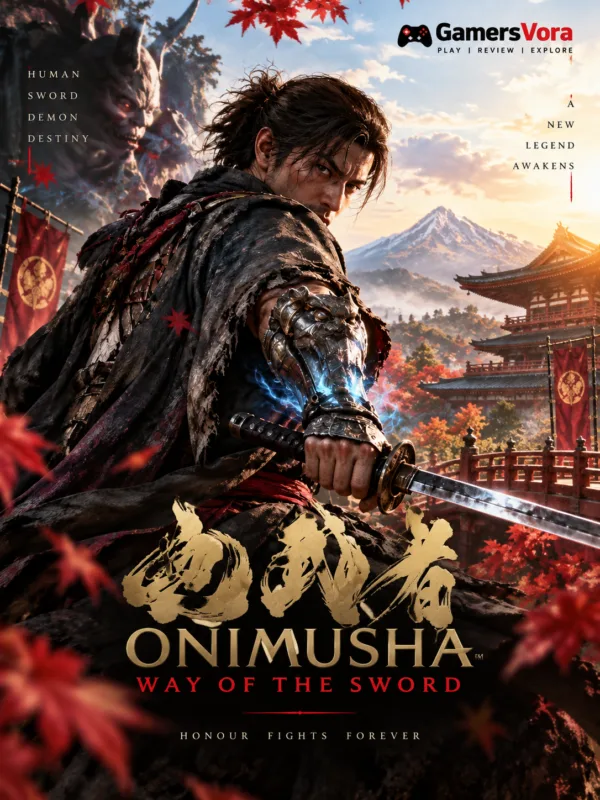
There is a particular sound that tells you what Onimusha: Way of the Sword wants to be.
Not an explosion. Not an orchestral swell. The sharp metallic crack of two blades meeting at exactly the right moment.
Released on September 4, 2026, Onimusha: Way of the Sword marks Capcom’s full-scale return to a series that had spent years away from the spotlight. But this isn’t a revival built simply to remind players of the PlayStation 2 era. The foundations are recognizable — a lone swordsman, demonic Genma, the supernatural Oni Gauntlet and the satisfying act of ripping souls from defeated enemies — yet almost every part of that formula has been rebuilt around much more involved sword combat.
This time the swordsman is Miyamoto Musashi, one of the most famous figures in Japanese history, dropped into a twisted early Edo-period Kyoto where demonic creatures have begun bleeding into the human world.
And if the name Musashi already raises expectations for the swordplay, Capcom seems perfectly aware of it.
Capcom has brought Onimusha back after a long absence, but Way of the Sword doesn’t feel interested in surviving purely on memories of the PlayStation 2 era. The foundations are recognizable — a lone swordsman, demonic Genma, the supernatural Oni Gauntlet and the satisfying act of ripping souls from defeated enemies — yet almost every part of that formula has been rebuilt around much more involved sword combat.
This time the swordsman is Miyamoto Musashi, one of the most famous figures in Japanese history, dropped into a twisted early Edo-period Kyoto where demonic creatures have begun bleeding into the human world.
And if the name Musashi already raises expectations for the swordplay, Capcom seems perfectly aware of it.
Onimusha: Way of the Sword is less interested in giving players endless attacks to mash through and more interested in making individual clashes matter. Parries, deflections, dodges, Issen counters, supernatural Oni abilities and enemy stamina all interact to turn even ordinary fights into small duels.
The result is an Onimusha game that feels unmistakably connected to the old series while clearly being built for a modern action audience. PlayStation.Blog
A new Onimusha, but a very familiar conflict
At the center of Way of the Sword is Kyoto.
Not the peaceful historic city visitors know today, but an early Edo-period version transformed by Malice. Shrines, temples and streets have been corrupted, while creatures known as Genma have crossed into the world of the living.
Capcom describes these beings as monsters normally dwelling in the depths of hell. With Malice spreading across Kyoto, that separation between worlds has begun to collapse. xbox.com
That’s where Musashi enters the story.
He’s not initially presented as a chosen hero enthusiastically accepting some great supernatural responsibility. Quite the opposite.
Musashi arrives wanting to prove himself through his own skill with a sword. Through circumstance, however, the Oni Gauntlet becomes bound to him.
The gauntlet gives Musashi abilities far beyond those of an ordinary swordsman, including the power to absorb the souls released by defeated Genma. But early in the story, Musashi doesn’t particularly want it.
That friction gives Way of the Sword a useful character hook. Rather than beginning as a supernatural warrior who already understands his purpose, Musashi has to gradually come to terms with what has happened to him and decide what kind of fighter — and person — he intends to become. Capcom has said his outlook changes as the journey progresses and he becomes more accepting of his new role. PlayStation.Blog
There is also a wonderful piece of casting behind the character’s appearance.
Capcom based Musashi’s face on legendary Japanese actor Toshiro Mifune, whose performances became synonymous with samurai cinema around the world. That immediately gives this version of Musashi a visual connection to the films that helped shape popular perceptions of the wandering samurai. PlayStation.Blog
Combat is where Way of the Sword makes its strongest case
You can understand much of Way of the Sword by watching what happens when Musashi is attacked.
He doesn’t simply roll away and wait for another opening.
You can block.
You can parry.
You can deflect.
You can evade at exactly the right moment.
And, most importantly for longtime Onimusha players, you can risk an Issen.
The Issen has long been one of the defining mechanics of the series: counter an enemy at just the right moment and Musashi retaliates with an extremely powerful strike.
That idea survives here, but it’s surrounded by a much broader defensive system. The game constantly asks you to read what an enemy is doing rather than apply one response to everything. Capcom’s official demo material specifically highlights Parry, Deflect, Issen, Oni Armaments and soul absorption as central parts of the combat system. PlayStation.Blog
That makes fights feel less like reducing a health bar and more like trying to take control of the exchange.
An enemy swings.
Steel meets steel.
You force them backwards.
Their defense starts to unravel.
Then you turn that advantage into a decisive attack.
It’s a rhythm that works particularly well against bosses.
The stamina system changes how you approach stronger enemies
One of the smart additions to the combat is the emphasis on enemy stamina.
Against powerful opponents, simply landing standard attacks isn’t always the most meaningful way to make progress. Good defensive play — successfully reading and countering attacks — creates opportunities to break an opponent’s resistance and open them up to more damaging techniques.
It makes aggression feel earned.
Instead of constantly charging toward the enemy, you’re encouraged to learn their rhythm first.
A boss may attack quickly three times. Another may delay the final swing just long enough to catch someone who parries from muscle memory. Larger Genma might force you to decide whether a blow should be challenged or avoided altogether.
Once the system begins to click, defense stops feeling passive.
You’re attacking through defense.
That distinction is important because it gives Way of the Sword its own identity rather than turning it into another game where waiting for an opponent to finish an animation is the safest strategy.
Reflex Dodge rewards players who live dangerously
Parrying isn’t the only way to turn defense into offense.
Repeatedly avoiding attacks with properly timed Reflex Dodges fills a dedicated gauge. Once charged, Musashi can respond with a powerful Reflex Combo.
It’s another example of the game rewarding active defensive play.
The best action games often make the player feel most dangerous at the exact moment they are being attacked. Way of the Sword understands that idea.
A perfectly timed dodge isn’t merely an escape.
It’s preparation for retaliation. PlayStation.Blog
The Oni Gauntlet is much more than a story device
The Oni Gauntlet remains one of the most recognizable ideas in the series, but Way of the Sword builds considerably more around it.
Most obviously, it absorbs souls from fallen Genma. Those souls feed back into Musashi’s progression and supernatural capabilities.
The gauntlet also gives him access to various Oni powers that change both combat and exploration.
Oni Strength
Oni Strength is essentially supernatural brute force.
Capcom describes it as a way to break through stalemates and smash enemy defenses, but its usefulness extends beyond combat. It can also destroy barriers that would otherwise prevent Musashi from progressing through parts of Kyoto. PlayStation.Blog
Oni Agility
Oni Agility is the more mobile counterpart.
It gives Musashi bursts of supernatural speed and even allows him to run across particular walls, creating additional routes through environments. PlayStation.Blog
Oni Awakening
Then there is Oni Awakening.
Capcom showcased the ability ahead of release as a state in which Musashi unleashes the Oni power within him and overwhelms opponents with dramatically increased supernatural strength. PlayStation.Blog
Together, these abilities ensure the supernatural side of Onimusha isn’t simply reserved for cutscenes.
Musashi may want to become the greatest swordsman through his own ability, but the game continually puts incredibly powerful Oni tools in his hands and asks him — and the player — to use them.
That tension fits the character surprisingly well.
Oni Armaments bring another layer to the fighting
Musashi’s supernatural arsenal also extends beyond his regular katana.
The Oni Armaments offer additional ways to attack Genma and deal with situations that pure swordsmanship cannot solve as efficiently.
One of those tools is the Oni Bow, acquired as the adventure expands beyond its opening areas.
The bow isn’t simply a conventional ranged weapon bolted onto a melee game. It can interact with specific enemy mechanics and the environment.
That becomes particularly clear during one of the game’s strangest Genma encounters.
Which brings us to the bosses.
Sasaki Ganryu turns sword fighting into something personal
The demons may provide much of the spectacle, but one of Musashi’s most interesting opponents is another swordsman.
Sasaki Ganryu serves as Musashi’s rival and gives the combat a very different personality from the massive monsters surrounding him.
Capcom introduced Ganryu early because he neatly demonstrates what Way of the Sword is trying to achieve with duels.
Against a huge Genma, you’re studying mass, reach and monstrous attacks.
Against Ganryu, you’re studying a swordsman.
His movements are quicker. His strikes are deliberate. Timing becomes the focus.
The Kiyomizu-dera confrontation included in Capcom’s demo was designed to let players put Parry, Deflect, Dodge and Issen into practice against an opponent capable of answering Musashi with similarly dangerous swordsmanship. xbox.com
Ganryu is also more than a silent rival standing between Musashi and the next objective.
Capcom portrays him as eccentric and distinctly unsettling, creating a character whose presence contrasts nicely with Musashi’s more straightforward pursuit of strength.
And because the real Miyamoto Musashi and Sasaki Kojiro occupy such an important place in Japanese legend, even seeing Capcom reinterpret that rivalry through Onimusha’s supernatural mythology gives the story an intriguing historical foundation.
Daidara shows the other side of Way of the Sword’s bosses
If Ganryu represents the precision side of combat, Daidara moves in almost the opposite direction.
He’s enormous.
Brutal.
And built around the threat of sheer physical power.
Capcom added Daidara to the public demo shortly before release, giving players a chance to experience a boss that demands very different reactions from Ganryu. PlayStation.Blog
That’s important for an action game heavily based around parrying.
When every opponent can be defeated through exactly the same rhythm, a deep defensive system can quickly become predictable.
Bosses like Daidara allow Capcom to play with the timing, weight and visual language of incoming attacks. Reading the blade of a rival samurai and reading the movement of a gigantic Genma should not feel identical.
Way of the Sword understands that difference.
Rasho-gan might be the clearest example of Onimusha’s dark fantasy
Then there’s Rasho-gan.
This may be one of the best examples of how strange Way of the Sword is willing to become.
Rasho-gan inhabits Yasui Konpiragu Shrine, where it poses as a deity capable of granting people’s wishes.
Unfortunately, Genma interpretations of human desires are not particularly compassionate.
Capcom describes the creature as being assembled from parts of its victims. One grim example involves a man seeking relief from pain in his knee — Rasho-gan responds to the problem in the most horrifyingly literal way possible.
The creature’s many limbs aren’t just disturbing decoration, either.
Rasho-gan uses strange threads extending from its body to manipulate the battlefield, lifting objects and even large pieces of the surrounding environment to attack Musashi. The Oni Bow becomes useful for interfering with those mechanics, meaning this encounter forces players to use more than their basic sword toolkit. PlayStation.Blog
This is exactly the type of boss Onimusha benefits from.
It isn’t merely large.
It tells a story through what it is.
Rasho-gan takes something recognizably human — asking a deity for help — and turns it into grotesque Genma logic.
Byakue turns a fight into a contest of control
Another Genma shown prominently by Capcom is Byakue.
Musashi encounters the creature while dealing with strange plants responsible for spreading a life-draining fog across Kyoto.
Byakue is much more animalistic than Ganryu or Rasho-gan. During the confrontation, its aggression increases as the battle continues, creating a fight where understanding when to commit becomes more important than simply attacking continuously.
Capcom’s own gameplay description points toward a deliberate solution: fewer, more powerful attacks can prove more effective than constant pressure. PlayStation.Blog
That’s a small detail, but an encouraging one.
Good boss design shouldn’t just test whether players have learned the controls.
It should test whether they understand when to use them.
Kyoto gradually opens as Musashi becomes stronger
Way of the Sword isn’t structured as one enormous open world.
Instead, missions begin in more focused environments before portions of Kyoto open into broader spaces containing exploration opportunities, supernatural barriers and additional objectives.
Clearing Malice and acquiring new Oni abilities can give Musashi access to places he couldn’t previously reach. PlayStation.Blog
That structure arguably suits Onimusha.
The series works well when locations feel handcrafted and dangerous rather than simply enormous.
Capcom can build a temple around a specific encounter, then allow the game to breathe when Musashi returns to larger areas.
And Kyoto is a strong setting for exactly that kind of design.
Real-world shrines and temples such as Kiyomizu-dera are transformed through the game’s dark-fantasy interpretation, letting familiar Japanese architecture exist alongside impossible Genma corruption. xbox.com
Dynamic dismemberment makes every sword strike feel nastier
Capcom has also put considerable work into how the sword physically interacts with enemies.
The developers call one part of this system dynamic dismemberment.
When Musashi cuts into certain Genma, the resulting damage can correspond to the direction of his sword stroke rather than playing the same canned enemy-death animation every time.
A horizontal attack can cut differently from a vertical one.
It’s a detail that might sound cosmetic, but it contributes to something extremely important in a sword game: impact.
If Way of the Sword wants players to care about individual strikes, those strikes need to look and sound convincing.
Here, combat isn’t only about timing.
It’s about making that timing feel good once the blade finally lands. PlayStation.Blog
This Musashi story is about more than becoming stronger
Perhaps the most interesting part of Way of the Sword is that Musashi’s initial motivation is almost refreshingly uncomplicated.
He wants to prove himself.
He wants to become unmatched with a sword.
Then the game surrounds that relatively simple ambition with demons, suffering civilians, supernatural responsibilities and an Oni Gauntlet he never asked for.
That gives the adventure somewhere to go emotionally.
The question gradually stops being simply:
How strong can Musashi become?
It becomes:
What is that strength actually for?
Capcom has been fairly open about Musashi’s changing attitude toward his role without giving away the destination of that arc. That’s probably the right balance for a game whose story is worth discovering rather than summarizing before people play it. PlayStation.Blog
Where to Buy Onimusha: Way of the Sword
Onimusha: Way of the Sword is available digitally on PlayStation 5, Xbox Series X|S, and PC. Choose your platform below to visit the official store.
PlayStation 5
Available from the PlayStation Store. The Indian PlayStation Store currently lists the Standard Edition at ₹4,399, alongside Deluxe and Premium Deluxe editions. PlayStation
Buy on PlayStation Store
Xbox Series X|S / PC
The Xbox Store lists the Standard Edition at ₹4,399 in India. It also supports Xbox Play Anywhere, allowing an Xbox digital purchase to be played on supported Xbox consoles and Windows PC. xbox.com
Buy on Xbox Store
PC — Steam
PC players can purchase the game directly through Steam. The Steam version includes single-player support, achievements, Steam Cloud and HDR. Steam Store
Buy on Steam
One important change I’d make for GamersVora
Don’t hard-code prices into the permanent Game page unless your website has a system to update them.
Prices change because of sales, regional pricing and promotions. Instead, the permanent section could simply show three attractive buttons:
PLAYSTATION 5 → Buy on PlayStation
XBOX SERIES X|S → Buy on Xbox
PC → Buy on Steam
Why Onimusha: Way of the Sword feels like more than a revival
There was an easy version of this comeback Capcom could have made.
Bring back the Oni Gauntlet.
Put a samurai in a haunted Japanese castle.
Add modern graphics.
Play the nostalgia card.
Instead, Way of the Sword tries to answer a harder question:
What should an Onimusha game actually play like in 2026?
Its answer appears to be found in the space between old and new.
The Genma remain.
Soul absorption remains.
The Oni Gauntlet remains.
Issen remains.
But around those ideas Capcom has built a much more expressive combat system — one where parries, deflections, Reflex Dodges, stamina pressure, Oni Armaments and supernatural abilities give the player considerably more to think about during a fight.
Miyamoto Musashi is an equally smart choice at the center of it all.
His obsession with mastering the sword gives the game an excuse to make swordsmanship its defining feature. His historical legend gives Capcom rich material to reinterpret. And the unwanted Oni Gauntlet creates a natural conflict between the strength Musashi wants to earn and the supernatural power he has been given.
Then the Genma make everything wonderfully strange.
A grotesque wish-granting monster.
A giant creature that can overpower Musashi through sheer force.
A dangerous rival swordsman waiting for another duel.
A Kyoto slowly disappearing beneath clouds of Malice.
That mixture of historical fiction, supernatural horror and deliberately theatrical sword combat is exactly where Onimusha has always been most comfortable.
Way of the Sword doesn’t need to pretend the last two decades never happened.
It simply takes the soul of the series, puts a sharper blade in its hand, and asks it to fight again.


Sign in to Comment
Join the Gamersvora community
Create a free account or sign in to comment and reply. This keeps conversations safer and reduces spam.