
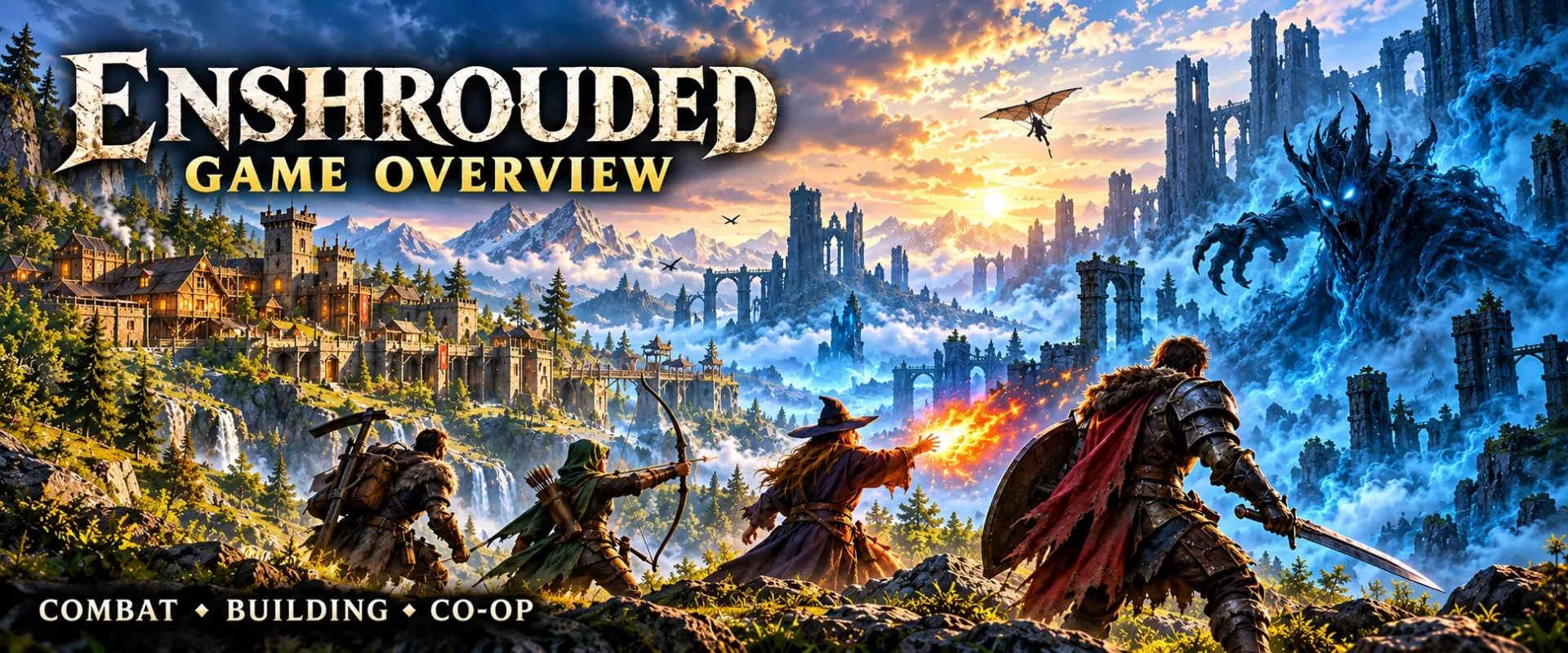

A ruined kingdom gives you plenty of reasons to go adventuring. Enshrouded adds a reason to come home: the settlement you build helps support your next expedition. Rescued craftspeople expand your options, resources become equipment, and a patch of wilderness gradually becomes somewhere worth returning to.
That relationship is what interests me most about Keen Games’ fantasy survival action RPG. Exploration, construction and character development feed into each other. A successful trip can change both your character and the home waiting behind them.
With its full release approaching, here is how Enshrouded fits together—and what to know before stepping into Embervale.
Research-based overview. Information checked on October 14, 2026.
Game at a Glance
| Detail | Information |
|---|---|
| Developer and publisher | Keen Games |
| Genre | Survival action RPG with crafting and base building |
| Setting | Embervale, a fallen fantasy kingdom |
| Current status | Available in Steam Early Access |
| Early Access release | January 24, 2024 |
| Version 1.0 | Scheduled for October 15, 2026 |
| Launch platforms | PC and PS5, including PS5 Pro support |
| Modes | Single-player and online co-op |
| Co-op capacity | Up to 16 on PC; up to 8 on PS5 |
Release and platform details come from the Steam listing, official release announcement and PlayStation Store.
Embervale Is a World You Can Reshape
You play as a Flameborn, awakening in a kingdom consumed by a corrupting fog called the Shroud. Reclaiming that world provides the story’s central purpose, while its abandoned settlements and dangerous wilderness give you somewhere to begin.
Embervale is handcrafted, with terrain that can be reshaped through voxel-based tools. That distinction matters: the landscape has deliberately arranged places to discover, while construction gives you room to leave a personal mark on it. Official game overview
The appeal depends partly on how much you enjoy making your own priorities. Following a quest, improving a workshop and gathering materials for a larger home all contribute to progress. If you prefer a tightly directed campaign, that freedom may sometimes feel like several jobs competing for your attention.
Exploration Makes Preparation Matter
The Shroud turns parts of the map into timed expeditions. Your protection lasts only so long inside it, making the return journey part of the decision to push deeper. Character progression and other boosts can extend that window. Shroud timer reference
I think that restriction gives preparation a useful purpose. Better equipment helps with enemies, but knowing when to retreat matters too. Another discovery is less attractive if reaching it leaves no comfortable route back.
Traversal adds another consideration. Gliders let you travel from elevated ground, while grappling hooks connect you to designated anchors across gaps and above obstacles. The hook’s anchor requirement is worth understanding: it is a tool for particular routes, rather than unrestricted climbing. Official grappling-hook wiki
Learning the terrain therefore has value beyond clearing markers. Height, crossings and escape routes become practical knowledge.
Combat and Progression Support Different Builds
Melee weapons, ranged attacks and magic give you different ways to approach encounters. Character development lets you specialize or combine abilities, so your preferred role can grow alongside the equipment you discover.
Returning players should pay attention to the April 2026 Forging the Path update. It introduced melee heavy attacks, weapon special abilities powered by a resource called Focus, and revised attack chains for several two-handed weapons. Its skill-tree changes added upgradeable skills and more connections between character paths. Armor, shields, wards and rings also gained upgrade systems. Official Update 8 notes
Those changes make older build advice worth checking carefully. Choosing a weapon now connects to decisions about its abilities, your skill investment and equipment upgrades.
The design question that matters to me is whether those choices support noticeably different approaches to encounters. The documented systems provide that foundation; judging their balance across a complete playthrough would require hands-on testing.
Building Gives Your Adventures a Home
Enshrouded’s construction tools support detailed structures and terrain alteration, including homes carved into hillsides. Rescued NPCs bring crafting services into your settlement, tying its practical value to the people you find outside it. Official building overview
That connection gives construction more purpose than a screenshot opportunity. A workshop helps prepare equipment; equipment supports exploration; exploration brings back resources and survivors.
There is a time commitment attached to that loop. Someone who enjoys arranging rooms may happily spend an evening improving a base. Someone waiting for the next fight may want to keep construction functional.
Difficulty options help accommodate those preferences. The Relaxed preset reduces enemy pressure and increases resources and loot, while harder presets increase the challenge. Custom settings offer further control. I would start with the recommended Default setting, then adjust the parts your group finds frustrating. Official gameplay-settings guide
Co-op Has Important Platform Differences
Solo play is supported, and PC co-op accommodates up to 16 players. The PS5 listing specifies up to eight online players and requires PlayStation Plus for online multiplayer. It also lists controller remapping and adjustable difficulty among its accessibility options. PlayStation details
Crossplay will not be available at the 1.0 launch. Keen Games says it is working on the feature but has no estimated arrival date. Friends buying on different platforms should account for that before planning a shared world. Official launch FAQ
For a group, agreeing on priorities may matter as much as choosing builds. Exploring together works best when everyone is comfortable with how much time goes into gathering and construction.
What Version 1.0 Changes
The October 15 update is scheduled to open the complete map, introduce Cinder’s Cradle, and raise the character level cap to 50. Its published notes also describe expanded spell options and Sparkworks, a logic system for creating interactive puzzles, traps and encounters in player-built spaces. These are announced launch additions, rather than features already released as of this article’s date. Official 1.0 changelog
Existing PC Early Access owners will receive 1.0 without buying again. Their saves will remain usable, although Keen recommends considering a fresh start to experience the revised opening. Launch FAQ
PC Requirements and Performance Expectations
Steam currently lists these requirements:
| Component | Minimum | Recommended |
|---|---|---|
| CPU | Core i5-6400 / Ryzen 5 1500X | Core i7-8700 / Ryzen 7 2700X |
| RAM | 16 GB | 16 GB |
| GPU examples | GTX 1060 / RX 580 / Arc A380 | RTX 2070 Super / RX 6700 XT / Arc A770 |
| Storage | 60 GB | 60 GB; SSD recommended |
Both tiers list Windows 10 and a 64-bit processor and operating system. These specifications do not establish a guaranteed frame rate. Steam requirements
Keen’s 1.0 notes describe rendering and memory improvements, but their practical impact needs assessment in the released build.
Enshrouded’s strongest fit is someone who wants adventures to support a longer project: a character, a settlement, or a shared world with friends. I would choose it for that ongoing relationship between discovery and creation. The deciding question is whether coming home to build sounds as appealing as heading out to fight.

Sign in to Comment
Join the Gamersvora community
Create a free account or sign in to comment and reply. This keeps conversations safer and reduces spam.