
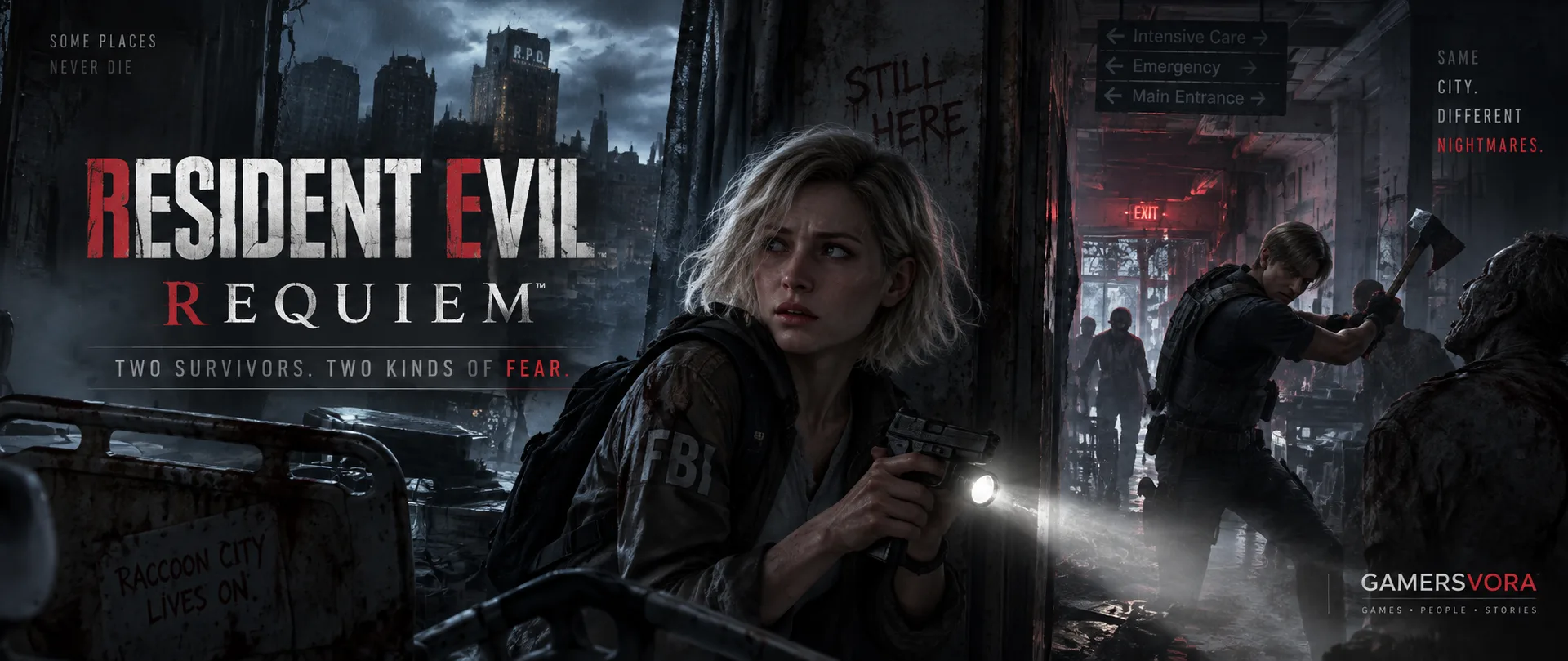
Grace Ashcroft makes you think twice about opening the next door. Leon S. Kennedy makes you wonder whether the monster behind it picked the wrong fight. Resident Evil Requiem somehow finds room for both.
There is a simple way to understand what Resident Evil Requiem is trying to do.
Put Grace Ashcroft in a corridor with something horrible blocking the way and suddenly every bullet feels expensive. Is there another route? Can the creature be distracted? Do you really want to burn through ammunition when you may need to come through this room again?
Put Leon S. Kennedy in a similar situation and your priorities change.
Now you’re wondering whether a shotgun blast will stagger the thing long enough to close the distance with a hatchet.
That contrast is Requiem’s identity.
Resident Evil has spent decades moving between survival horror and action, occasionally finding a beautiful balance and occasionally wandering much too far in one direction. Requiem doesn’t really try to settle the argument. It gives both sides their own protagonist.
Grace carries much of the vulnerability, resource anxiety and dread. Leon brings experience, heavier firepower and the sort of spectacular violence you’d expect from the man who survived Resident Evil 4.
Capcom director Koshi Nakanishi confirmed that this contrast was intentional in an official Resident Evil Requiem developer interview, describing Grace’s sections as more horror-focused while Leon’s lean toward exhilarating action and provide periods of relief between stretches of tension. PlayStation.Blog
The transition isn’t always elegant. Sometimes Requiem genuinely feels like two different Resident Evil games sharing the same box.
But more often than not, that’s exactly why it works.
Grace Ashcroft makes ammunition feel expensive again
Grace is one of the smartest choices Capcom made for Requiem because she doesn’t enter this story pretending she belongs here.
She’s an FBI intelligence analyst, not another battle-hardened bioweapon specialist. Her investigation eventually leads into a deeply personal nightmare connected to her mother, Alyssa Ashcroft, and Raccoon City’s history.
That lack of combat experience isn’t just background information.
Capcom designed Grace around vulnerability. Producer Masato Kumazawa explained in an official PlayStation interview that Grace was intended to reflect the player’s own fear: her breathing becomes unsettled in dark corridors, she reacts visibly when surprised, and her character develops as she confronts increasingly horrifying situations. PlayStation.Blog
It matters because her sections aren’t built around clearing every room.
Grace starts with a classic eight-slot inventory. That immediately brings back one of Resident Evil’s oldest pleasures: finding something useful and then discovering you don’t have anywhere sensible to put it.
Ammunition competes with healing supplies. Puzzle items compete with weapons. Something you’re carrying because it might become useful later suddenly looks much less important when there’s something you desperately need sitting on a table.
And enemies become decisions rather than targets.
A zombie standing between Grace and the next room doesn’t automatically need to die. Sometimes killing it is the right choice. Sometimes getting around it and keeping six bullets in the magazine is considerably smarter.
That’s survival horror.
Not simply making the monster stronger.
Making the decision to fight it expensive.
Grace’s blood-crafting system is wonderfully unpleasant
Requiem gives Grace another reason to think carefully about the infected.
Their blood can be useful.
Rather than relying only on conventional crafting materials, Grace can collect blood from enemies and the environment and use it to craft ammunition and other survival items.
It is exactly the sort of disgusting little idea Resident Evil is good at.
The corpse on the floor can be frightening, dangerous and potentially valuable at the same time.
The mechanic also prevents Grace’s vulnerability from becoming helplessness. She’s underprepared, but she isn’t useless. Surviving means learning what the environment can provide and deciding when those resources are worth spending.
There’s an important difference there.
A horror protagonist who simply can’t fight can eventually make encounters feel binary: hide or die.
Grace has options.
They’re just rarely comfortable ones.
And then Leon walks in
Leon S. Kennedy has been doing this for nearly three decades.
Pretending otherwise would have been ridiculous.
His first day as a police officer turned into the Raccoon City Incident, and everything since has involved parasites, bioweapons, conspiracies and creatures that should never have been allowed anywhere near human DNA.
Requiem understands that you cannot put this version of Leon in a room with one zombie and expect the audience to worry about him.
So it doesn’t.
His sections pull heavily from the combat language Capcom perfected with the Resident Evil 4 remake: firearms, positioning, melee attacks, staggering enemies and turning a dangerous room into a violent playground.
And then there’s the hatchet.
Capcom’s official Leon S. Kennedy gameplay breakdown goes into considerable detail about the weapon. Leon can use it for direct melee attacks, stronger charged strikes, stealth takedowns and timed parries. Unlike the combat knife in Resident Evil 4, the hatchet doesn’t disappear when its sharpness is exhausted; Leon can sharpen it again. PlayStation.Blog
That small change makes it feel less like a consumable and more like part of Leon’s combat identity.
Then Requiem lets him parry a chainsaw with it.
Of course it does.
Better still, kill the infected carrying that chainsaw and Leon can pick it up himself.
Resident Evil can be terrifying one minute and completely ridiculous the next. Somehow, the series is usually better for it.
One monster, two completely different problems
This is where Requiem’s dual-protagonist idea becomes more than a gimmick.
PlayStation’s official hands-on describes encountering a Blister Head while controlling Grace. Even unloading several magazines wasn’t enough to solve the problem.
Leon?
A few shotgun blasts followed by a hatchet finisher.
The same preview describes another huge creature, Chunk, where Grace’s sensible answer was essentially get away from this thing. Leon could stun it with repeated shotgun blasts before following up with heavy hatchet attacks. PlayStation.Blog
That’s a much better distinction than simply giving Leon more health.
Requiem changes your attitude.
With Grace, a dangerous enemy makes you look for exits.
Where’s the door?
Can I sneak around?
Can I distract it?
How much ammunition will this cost?
With Leon, your brain starts asking different questions.
Can I stagger it?
What’s behind me?
Can I parry that attack?
How close can I get before swinging the hatchet?
Same horror game.
Completely different psychology.
The two campaigns actually remember each other
Capcom could have stopped there.
Grace gets horror levels. Leon gets action levels. Alternate between them until the credits.
Requiem is more interesting than that.
Their actions can persist across shared locations.
Nakanishi confirmed in the official developer interview that enemies Grace kills remain dead when Leon later enters the same location, while items left on the ground can remain there too. He specifically discusses the strategic possibility of Grace avoiding enemies because Leon may be better equipped to deal with them later. PlayStation.Blog
It’s a seemingly small detail with interesting consequences.
Suddenly, not killing something can be planning rather than cowardice.
Grace might spend valuable ammunition clearing an area now. Or she might leave the problem behind knowing that somebody considerably better equipped could eventually return.
That gives Requiem’s two halves a physical connection.
They’re not simply visiting Horror Level A and Action Level B.
They’re surviving the same nightmare under different rules.
The split personality is also Requiem’s biggest risk
There’s a downside.
Grace can build tension beautifully. Limited supplies, narrow spaces and the possibility that fighting is the wrong decision create the sort of sustained unease Resident Evil 7 understood so well.
Then Leon arrives with a shotgun and a hatchet.
For some players, that’s going to feel fantastic—a release after prolonged pressure.
For others, it may break the spell.
GameSpot’s review makes a similar argument, describing Requiem as an excellent refinement of Resident Evil’s horror and action formulas while observing that the two sides can feel almost like separate games running alongside one another. GameSpot
That’s a fair criticism.
The game isn’t always blending horror and action.
Sometimes it’s switching between them.
But I think that’s preferable to the obvious alternative: weakening both until they comfortably fit together.
Grace shouldn’t suddenly become an action hero because Leon exists.
Leon shouldn’t forget 30 years of experience because the game wants another scary corridor.
Allowing them to remain different is messier.
It’s also more interesting.
Raccoon City earns its place in the story
Bringing back Raccoon City was dangerous for another reason.
Nostalgia sells.
Put Leon in front of a familiar building, play the right piece of music and longtime Resident Evil fans are already halfway there.
Requiem could easily have become an anniversary tour.
Instead, Raccoon City feels more like an old wound.
Leon survived what happened there.
Grace inherited its consequences through her mother.
Nakanishi explains that Leon’s return to Raccoon City is important precisely because it is where his nightmare began, while Grace provides a perspective for newcomers who know little or nothing about the original incident. PlayStation.Blog
That gives the setting purpose beyond recognition.
The city wasn’t rescued after the 1998 outbreak.
It was destroyed.
Returning decades later means exploring the remains of something Resident Evil has spent years talking about as history.
Leon sees a place he remembers.
Grace sees a disaster she knows partly through somebody else’s life.
That difference is far more useful than simply putting both characters beside a famous R.P.D. sign.
Requiem’s zombies are worth watching before shooting
One of the smaller enemy-design ideas fits Grace particularly well.
Some infected retain strange fragments of behaviour from their previous lives.
They’re not suddenly friendly.
This is still Resident Evil.
But rather than every zombie functioning like an identical obstacle waiting for the player to enter its detection radius, some retain routines that can tell you something about how they behave.
That makes observation useful.
And when ammunition is precious, useful information is valuable.
There’s something wonderfully old-school about entering a room, spotting an infected creature and spending a few seconds watching it rather than immediately firing.
Can it be avoided?
What attracts it?
Where does it move?
Do I actually need to go near it?
With Leon, those questions often become less important because he has more convincing ways of controlling a fight.
Again, Requiem gets mileage from changing what the same type of threat means depending on who’s standing in front of it.
First person and third person almost feel like difficulty settings for fear
Requiem allows both Grace and Leon to be played in first or third person.
That’s easy to dismiss as a camera preference.
It isn’t.
First-person horror removes information.
You can’t casually see what’s behind your character. Turning around becomes an actual commitment. A creature charging toward you occupies far more of your vision.
In third person, there’s a little more breathing room.
Nakanishi said Capcom recognised that some players found first-person Resident Evil too frightening but could still enjoy the experience in third person. The team even differentiated how the characters look while aiming in first person: Grace’s hands shake because she lacks Leon’s combat experience and reacts more heavily to recoil. PlayStation.Blog
That’s a fantastic character detail.
It tells you something without dialogue.
Grace isn’t holding the gun like Leon because she isn’t Leon.
The perspectives also suit each character differently.
First person makes Grace’s narrow hallways more claustrophobic.
Third person lets Leon’s physical combat breathe—parries, movement and brutal hatchet strikes become part of the spectacle.
There’s no correct camera.
Experiment.
You may find yourself wanting a different one depending on who’s currently trying not to die.
The puzzles remember what Resident Evil is supposed to be
A Resident Evil puzzle doesn’t need to make you reach for a notebook and study advanced mathematics.
It needs to make you pay attention.
Requiem understands this.
Locked doors matter. Objects need examining. A strange item picked up twenty minutes ago may suddenly make sense when you encounter the right mechanism. Areas worth revisiting become lodged in your memory.
There was a cabinet back there.
That door still hasn’t opened.
Didn’t I see somewhere this object might fit?
That’s the good stuff.
And it works because Requiem isn’t trying to become an enormous open world.
There isn’t a giant landscape covered with icons asking you to clear six zombie camps and collect 40 biological samples before the next story beat.
Its spaces can be learned.
PlayStation’s earlier hands-on demonstration of Grace’s gameplay showed this design clearly: locked doors, a fuse needed to progress, environmental puzzles, hiding from a pursuing creature, using thrown objects as distractions and even manipulating lighting to avoid detection. PlayStation.Blog
That’s Resident Evil doing what Resident Evil does best.
Making a relatively small space feel enormous because you’re afraid of crossing it.
RE ENGINE helps, but lighting and sound do the real work
Requiem is technically impressive.
Capcom has continued evolving the RE ENGINE, and producer Masato Kumazawa specifically highlighted details such as Grace’s hair, sweat, facial movement and subtle trembling as examples of what the technology contributes. PlayStation.Blog
But polygon counts aren’t why the game looks unsettling.
Lighting is.
Resident Evil has long understood that darkness needs structure.
A completely black room isn’t automatically frightening. A room where you can see almost enough is.
A silhouette.
A doorway.
Something that might have moved.
Sound fills in whatever the eyes can’t confirm.
Footsteps from somewhere you can’t see.
Something scraping against the floor.
A noise from the room you’re about to enter.
Then nothing.
Silence can do more work than another monster screaming into the camera.
Requiem’s technical presentation matters because it supports those moments rather than overwhelming them.
The story works best when Resident Evil keeps things personal
There’s plenty of franchise history surrounding Requiem.
Raccoon City. Umbrella. Alyssa Ashcroft. Leon. Decades of biological disasters.
Capcom could have drowned the game in lore.
Instead, the strongest foundation is much simpler.
Grace is dealing with something connected to her mother.
Leon is returning to the place where his life changed.
That’s enough.
It gives series veterans plenty to recognise without turning every conversation into an explanation of something that happened three games and 20 years ago.
It also makes Grace particularly useful for newcomers.
Nakanishi explicitly says Requiem was designed so somebody unfamiliar with the Raccoon City Incident can enter the series alongside her. PlayStation.Blog
Veterans will inevitably get more from certain connections.
But Resident Evil homework isn’t mandatory.
That’s important for a ninth mainline entry in a franchise celebrating three decades.
Does Requiem rely too heavily on Resident Evil’s greatest hits?
A little.
This is probably the criticism that sticks hardest.
Requiem knows exactly what Resident Evil fans like.
Raccoon City.
Leon.
Inventory management.
Puzzles.
Resident Evil 7-style vulnerability.
Resident Evil 4-style combat.
Grotesque monsters.
Backtracking.
A shotgun appearing exactly when things are becoming unpleasant.
There is something undeniably greatest-hits about the recipe.
PC Gamer’s review reached the positive side of that same conclusion, arguing that Requiem successfully brings together many of the strongest elements from previous Resident Evil games and awarded the game 92/100. PC Gamer GameSpot was more reserved at 8/10, praising the refinement while arguing that the game sometimes depends too heavily on the franchise’s previous successes. GameSpot
Both readings make sense.
Requiem isn’t Resident Evil tearing up its rulebook.
It’s Capcom looking at three decades of rulebooks, circling the pages that worked and trying to put them into one game.
For somebody tired of Resident Evil, that may not be enough.
For somebody who still enjoys this particular mixture of resource anxiety, puzzle solving, grotesque horror and ridiculous action?
It’s difficult to complain when the ingredients are this good.
How long is Resident Evil Requiem?
Requiem isn’t built as a sprawling 40-hour adventure, and that’s probably for the best.
Its structure benefits from momentum. Horror becomes harder to sustain when a game keeps inventing reasons to send the player across an oversized map.
Published reviews describe a comparatively compact campaign rather than an open-ended experience. PC Gamer specifically characterised its roughly ten-hour run as tightly paced, with puzzles, corridors and action generally avoiding unnecessary repetition. PC Gamer
Actual completion time will naturally vary depending on difficulty, exploration, puzzle solving and repeat playthroughs.
And repeat runs are particularly interesting here because Grace and Leon’s overlapping spaces give knowledgeable players opportunities to approach resource use differently.
Knowing what Leon can deal with later might change what Grace bothers fighting now.
That’s a more interesting reason to replay than simply chasing a faster completion time.
Is Resident Evil Requiem worth playing?
Requiem makes the easiest case for itself to players who have spent years wishing Resident Evil would stop choosing between survival horror and action.
Grace provides the former without being completely helpless.
Leon delivers the latter without turning the entire game into a shooting gallery.
The puzzle design keeps exploration relevant. Raccoon City gives the story genuine history. Switchable perspectives let players decide how intimate they want the horror to become.
The biggest question is whether you’ll enjoy both halves equally.
Someone who loves Grace’s vulnerability may resent the moment Leon’s firepower punctures that carefully built tension.
Someone arriving primarily for Resident Evil 4-style combat may occasionally wish Grace would stop hiding and find a bigger shotgun.
That’s the risk Capcom took.
But it’s also Requiem’s personality.
Thirty years into Resident Evil, another attempt to decide whether the franchise should be scary or exciting would have been boring.
Requiem’s answer is simpler.
Why choose?
Verdict
Resident Evil Requiem’s strongest idea is refusing to make Grace Ashcroft and Leon S. Kennedy play by the same rules. Grace turns ammunition, inventory space and dark corridors into meaningful decisions; Leon transforms many of those same threats into aggressive, satisfying combat encounters. The transition between horror and action isn’t always seamless, and the game knowingly draws from Resident Evil’s greatest hits, but its compact exploration, puzzles, enemy design and return to Raccoon City give those familiar ideas purpose. For players who enjoy both sides of modern Resident Evil, Requiem makes a compelling case that the franchise doesn’t have to choose between fear and firepower.
GamersVora Rating
Not assigned — Critical Review / Editorial Analysis
I’m intentionally not inventing an 8/10, 9/10 or 9.2/10 here. Your Master Review Prompt requires a GamersVora score to come from a genuine GamersVora playtest and specifically prohibits fabricating a rating when the game hasn’t been personally tested.
For external critical context only, PC Gamer scored it 92/100, while GameSpot gave it 8/10.





Sign in to Comment
Join the Gamersvora community
Create a free account or sign in to comment and reply. This keeps conversations safer and reduces spam.