

Marvel’s Wolverine has never had the luxury of being just another superhero game.
Insomniac Games spent years teaching players what its version of Spider-Man should feel like: fast, acrobatic, playful and built around the freedom of New York. Logan presents almost the opposite design problem. He doesn’t swing above a fight. He walks into it. He doesn’t need a city full of icons to keep him occupied. Give him a reason to be angry, a room full of enemies and enough space to extend his claws.
Now that reviews for Marvel’s Wolverine are out ahead of its September 15 PS5 release, we finally have an answer to one of the bigger questions surrounding the project: did Insomniac resist the temptation to make Spider-Man with claws?
Mostly, yes.
Whether that resulted in a better game is where critics start disagreeing.
Early reviews paint Wolverine as a focused, violent and deliberately more linear action game built around Logan rather than around the open-world formula that helped define Insomniac’s Spider-Man series. Critics broadly recognize the appeal of that direction, but several also point to repetition, uneven storytelling and limited gameplay variety as the adventure progresses.
So rather than treating the review scores as the whole story, let’s look at what reviewers actually agree — and disagree — about.
Wolverine Isn’t Trying to Be Spider-Man
One of the most important things to understand about Marvel’s Wolverine is what it isn’t.
This isn’t an open-world superhero game.
Insomniac has built a single-player, narrative-driven action-adventure around Logan, and that narrower structure changes the rhythm immediately. Instead of spending hours clearing icons from a city map, Wolverine pushes through locations and set pieces as the story moves him forward.
That decision appears to be one of the game’s more interesting strengths.
The Verge, for example, found something refreshing in Wolverine’s return to a comparatively straightforward action-game structure. That’s significant because the industry has spent years stretching games outward — bigger maps, more side activities, more progression systems, more reasons to keep playing.
Wolverine goes in another direction.
There are quieter sections and opportunities to explore, but this is fundamentally an action game that wants to move Logan toward the next confrontation.
For this particular character, that makes sense.
Wolverine doesn’t need Manhattan to feel powerful. He needs enemies capable of surviving long enough for his abilities to matter.
The Claws Finally Feel Like Claws
There was always going to be one non-negotiable part of a Wolverine game: combat couldn’t feel clean.
Insomniac clearly understood that.
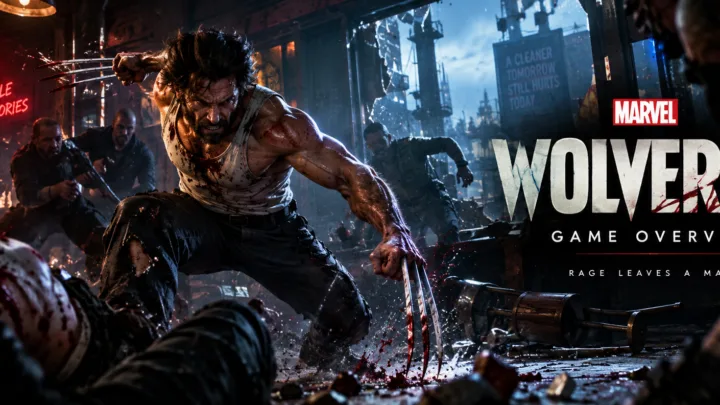
The studio describes the combat philosophy around “aggressive momentum,” with Logan fighting at close range using claws, kicks, barrages and critical strikes. The game also embraces blood and dismemberment rather than hiding Wolverine’s violence behind superhero-friendly presentation.
That immediately separates him from Insomniac’s Spider-Man.
Peter Parker can launch an enemy into the air, web him against a wall and move elegantly toward the next target. Logan’s fighting style is supposed to feel heavier and more uncomfortable. The distance between Wolverine and whoever he’s attacking is often very small.
Game Informer’s 8.5/10 review is among the more enthusiastic reactions, praising the momentum of the experience and Insomniac’s ability to translate another famous Marvel character into a videogame.
But combat is also where the critical split becomes obvious.
The Guardian’s review found the fighting increasingly repetitive despite the strength of Logan himself, arguing that the combat doesn’t maintain the creativity expected from the character. GamesRadar similarly questioned whether the underlying systems and progression do enough with Wolverine’s potential.
That’s an important distinction.
The disagreement isn’t really about whether Wolverine looks brutal.
He does.
The question is whether brutality alone can remain mechanically interesting after you’ve watched Logan tear through another group of enemies.
For some reviewers, the answer is yes.
For others, the claws lose a little of their edge through repetition.
Wolverine’s Healing Factor Creates an Interesting Design Problem
Wolverine has another problem that Spider-Man doesn’t.
He’s extremely difficult to kill.
That’s great for comic books. It’s awkward for a videogame.
If Logan can regenerate from horrific injuries, damage can’t work exactly as it does for an ordinary action-game protagonist. Insomniac’s solution ties Wolverine’s survivability closely to aggression and his emotional state, turning his rage into part of the combat loop rather than treating regeneration as background lore.
It’s a smart fit on paper because it encourages the player to behave like Wolverine.
Instead of constantly backing away from danger and waiting for a safe opening, the systems push toward confrontation. Logan becomes more convincing when the most effective response to trouble is often to get closer to it.
This is also where Wolverine’s narrower design helps.
The game doesn’t have to accommodate the movement systems of a Spider-Man-sized open world. Combat encounters can instead be constructed around enclosed spaces, enemies and cinematic sequences designed specifically for Logan’s abilities.
The result appears to be a game far more interested in Wolverine’s physical presence than superhero mobility.
Logan May Be Stronger Than the Story Around Him
Across the more critical reviews, one interesting pattern emerges: Logan himself often survives criticism that the broader story doesn’t.
Liam McIntyre voices James “Logan” Howlett, while Krizia Bajos plays Jean Grey. Familiar mutant names including Mystique and Sabretooth also appear as Insomniac builds its own Marvel universe around the character.
This isn’t presented as an X-Men ensemble adventure with Wolverine somewhere in the lineup.
Logan is the point.
That gives Insomniac room to deal with his anger, trauma, relationships and history rather than reducing him to the gruff guy with claws.
The Guardian was particularly positive about the conflicted character at the center of the game even while being far less convinced by the fighting surrounding him. Other reviews have similarly found individual character moments more compelling than parts of the larger narrative.
That creates an odd situation.
A Wolverine game can have a convincing Wolverine without necessarily having an equally convincing Wolverine story.
Some critics describe the narrative as predictable or uneven, while others respond more positively to its character work and cinematic approach.
For players coming primarily to spend time with Logan, that distinction may matter more than the aggregate score.
The Linear Structure Is Both a Strength and a Weakness
Linear has somehow become a dangerous word in modern games.
It shouldn’t be.
A tightly designed 12-to-15-hour action game can offer more memorable moments than an enormous map filled with repetitive activities. The question isn’t whether a game is linear. It’s what the developers do with that control.
Wolverine benefits when Insomniac uses linearity to control pacing, combat spaces and cinematic sequences.
It suffers when that same structure starts making the player’s path feel overly prescribed.
The Verge praised the simplicity of the overall approach while finding some of the exploration and missions less memorable. GamesRadar found parts of the experience restrictive and questioned whether enough mechanical depth develops around the structure.
These aren’t necessarily contradictory observations.
A game can benefit from abandoning an open world while still failing to make every corridor interesting.
The more useful question is whether Wolverine gives players enough meaningful decisions inside its linear framework.
That seems to be where critical opinion becomes much less consistent.
Not Every Review Sees the Same Wolverine
Game Informer’s 8.5/10 assessment sits on the enthusiastic side of the conversation.
Other outlets are considerably more reserved.
That gap is more interesting than simply saying the game is “mixed.”
Critics aren’t arguing about whether Insomniac made a functional Wolverine game. The character is recognizable, the violence is deliberate, the presentation carries blockbuster ambition and the combat has an immediate physicality.
The disagreement is about how long those strengths carry the experience.
One reviewer can see focused design where another sees restriction.
One can find satisfying aggression where another starts noticing repetition.
One can become invested in Logan’s internal conflict while another sees a familiar superhero narrative surrounding him.
Those differences are useful information for someone deciding whether to buy the game.
A review score can’t tell you which side you’re likely to land on.
Insomniac Hasn’t Forgotten About Replayability
Although Wolverine isn’t structured as a giant open-world game, Insomniac isn’t treating the end credits as an absolute stopping point.
The developer has confirmed New Game Plus, Mission Replay and Nightmare Challenges. Photo Mode is also planned through a day-one update.
New Game Plus includes additional Techniques and level caps, giving players a reason to revisit combat after finishing the story.
That’s particularly important for a game whose long-term appeal will depend heavily on how much players enjoy fighting.
If Wolverine’s combat clicks with you, replay-focused modes make sense.
If you’re already tired of its encounters before the credits, additional challenges probably won’t change the underlying problem.
Accessibility Is More Extensive Than You Might Expect
One area that shouldn’t get buried beneath combat and review scores is accessibility.
Insomniac says Marvel’s Wolverine includes more than 100 new, returning and improved accessibility features drawn from the studio’s previous work.
Those include High Contrast visuals, Audio Description in English, Global Game Speed and Strong Haptic Signals, among numerous other options.
The developer has also included separate controls related to violence and adult language. Blood and dismemberment can be adjusted, while English-language profanity can be filtered.
That’s an interesting choice for a game whose identity is so closely tied to violence.
Insomniac isn’t pretending Wolverine isn’t brutal. It’s allowing players some control over how explicitly that brutality is presented.
This Is a PS5 Game, Not a Cross-Generation Release
Marvel’s Wolverine launches September 15, 2026 for PlayStation 5 and is built specifically for Sony’s current-generation console.
There is no PS4 version.
PlayStation also confirms support for PS5 Pro features, including PlayStation Spectral Super Resolution (PSSR).
The game is available in Standard and Digital Deluxe editions, with the Deluxe version adding cosmetic suits and claws along with additional Technique Points.
For anyone planning to buy the game, however, the edition isn’t the biggest decision.
The bigger question is whether Wolverine’s particular kind of action game is what you’re looking for.
So, Should You Buy Marvel’s Wolverine?
Based on the current critical response, Wolverine looks easiest to recommend to players who want a focused single-player action game and are comfortable with a more linear experience.
If you’re coming specifically for Logan — his violence, personality, mutant abilities and close-range combat — Insomniac appears to understand the fundamental appeal of the character.
If you’re expecting the exploration freedom of Marvel’s Spider-Man, a huge open world or an action system that continuously reinvents itself across a long campaign, the reviews suggest adjusting those expectations.
And that’s probably the most useful conclusion to draw from the divided reception.
Marvel’s Wolverine doesn’t appear to be struggling because Insomniac failed to understand who Wolverine is.
If anything, the studio seems unusually committed to him.
The question is whether it found enough interesting things for that Wolverine to do.
For some critics, brutal combat, strong characterization and blockbuster presentation are enough to carry the experience.
For others, repetition and restrictive design eventually overpower those strengths.
That’s a much more interesting verdict than a number.
GamersVora Editorial Note
GamersVora has not independently completed or reviewed Marvel’s Wolverine. This article is a review roundup and critical analysis based on published professional reviews, official information from Insomniac Games and PlayStation, and verified pre-release material. No firsthand gameplay experience is claimed in this article.

Sign in to Comment
Join the Gamersvora community
Create a free account or sign in to comment and reply. This keeps conversations safer and reduces spam.