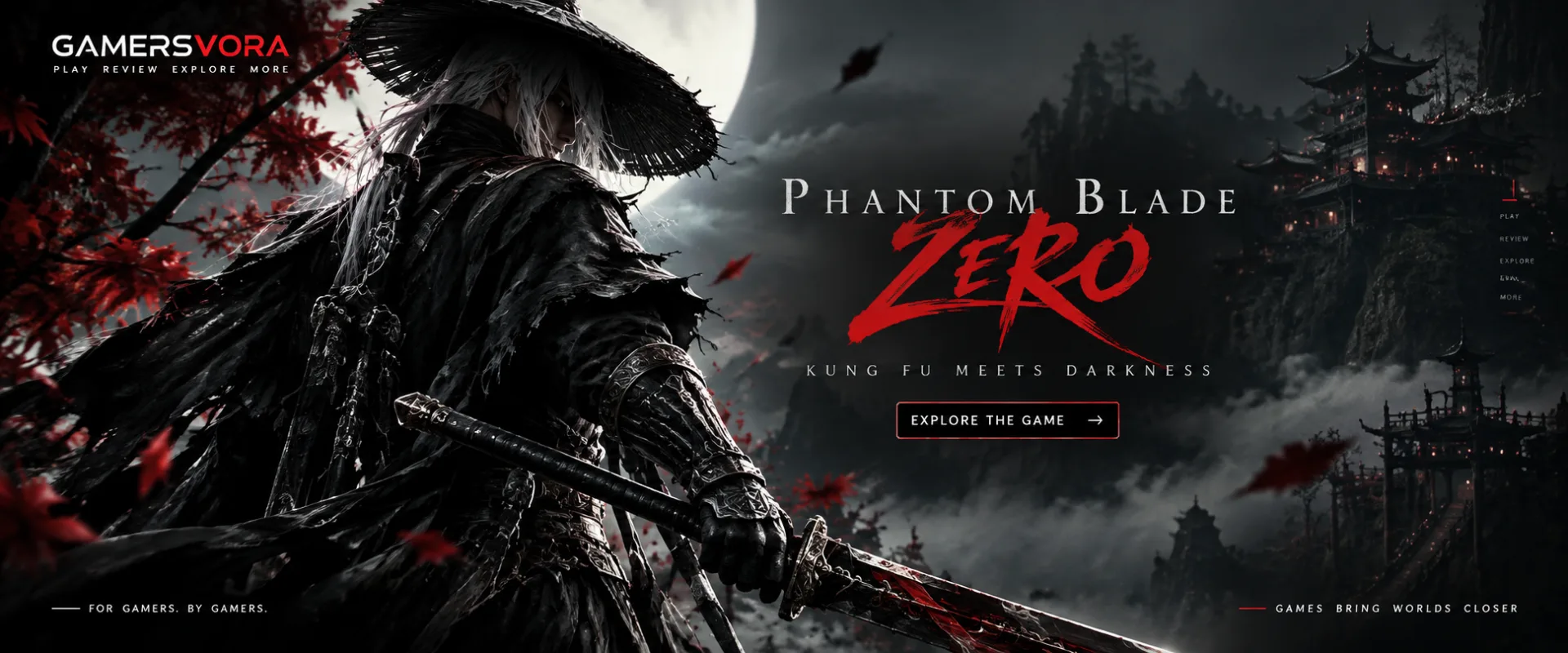
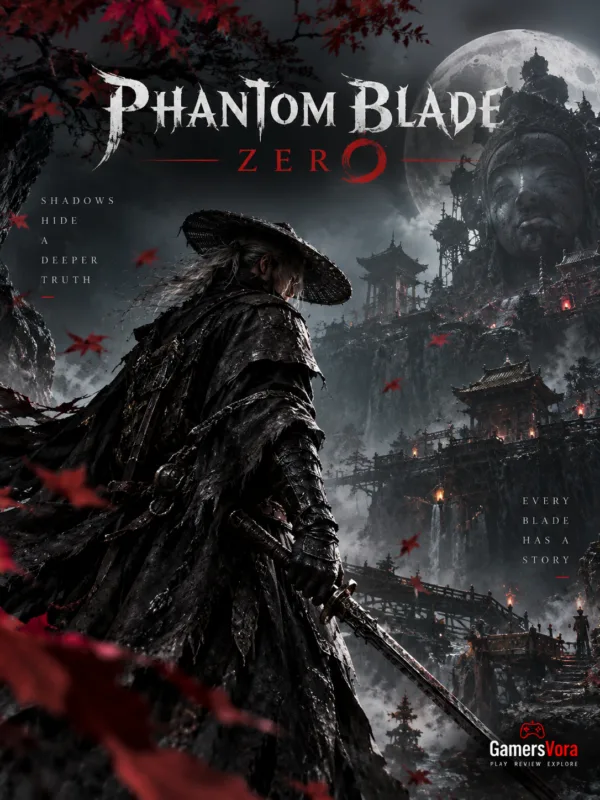
There is a moment in almost every Phantom Blade Zero combat showcase where the fight stops looking like a conventional video game encounter and starts resembling a choreographed martial-arts film.
Blades meet in a burst of sparks. A strike is deflected at the last possible instant. Soul slips around another attack, closes the distance and answers with a rapid sequence that looks considerably more complicated than the inputs apparently required to perform it.
That distinction matters.
Phantom Blade Zero is not simply trying to make sword fighting fast. Developer S-GAME is attempting to translate the rhythm and spectacle of classic wuxia action cinema into something players can actually control without turning every impressive exchange into a long sequence of difficult button combinations.
The result is one of 2026’s more distinctive action RPGs.
According to the official Phantom Blade Zero website, Phantom Blade Zero is scheduled for October 29, 2026, on PlayStation 5, with the PC version listed for October 28 in the US and select regions. Steam and the PlayStation Store are already accepting pre-orders.
The game was previously scheduled for September 9. In a June 2026 development update, S-GAME announced the delay, explaining that the additional development time would allow the team to continue refining the game before release.
And despite the inevitable comparisons to Sekiro, Ninja Gaiden, Devil May Cry and Soulslike games, S-GAME has been describing something slightly different: a dark wuxia adventure built around speed, weapon variety, exploration and cinematic kung fu.
Soul has 66 days left to solve his own murder mystery
The premise gives Phantom Blade Zero an unusually immediate reason to keep moving.
Players control Soul, an elite assassin connected to a powerful organization known as The Order. He is framed for the murder of the organization’s patriarch and badly wounded during the hunt that follows.
Soul survives, but not because he has miraculously escaped death.
A mystic healer gives him a temporary reprieve. He has only 66 days left to live.
S-GAME first laid out Soul’s predicament and the game’s central mystery in its original Phantom Blade Zero introduction on PlayStation Blog.
That turns the mystery into something personal. Soul needs to discover who framed him, why his master was killed and what larger conspiracy is unfolding across the martial world before his borrowed time runs out.
Later official material has added another layer to that story. Soul wanders the Wulin while being pursued by assassins and encountering martial-arts masters with their own motivations. Side quests can deepen the player’s understanding of the world, while some interactions may lead towards different story paths.
The game therefore does not appear to be structured as a simple procession of combat arenas connected by cinematics. There is a mystery driving Soul forward, but S-GAME is also leaving room for optional discoveries and smaller stories along the way.
The Phantom World mixes wuxia with something much stranger
The setting is arguably as important to Phantom Blade Zero as its protagonist.
S-GAME calls its visual and thematic mixture “Kungfupunk.”
Traditional Chinese martial arts sit beside occult forces, strange machinery, mechanical prosthetics, industrial ruins and dark fantasy imagery. The studio’s early descriptions of the Phantom World brought together Chinese kung fu, machinery and supernatural elements rather than treating the setting as straightforward historical fiction.
That explains why footage can move from recognisable sword duels to grotesque enemies and bizarre contraptions without feeling as though the game has suddenly entered another universe.
It is wuxia, but deliberately distorted.
S-GAME has cited the broader evolution of kung fu in popular culture as part of its inspiration, while action director Kenji Tanigaki has helped translate martial-arts choreography into the game’s animation.
More recently, Donnie Yen joined the project as a creative consultant and performs facial and motion capture for Mó Yuan, Soul’s father.
That involvement is more meaningful than simply putting a famous martial artist’s name in the credits. The project’s central challenge is making fights carry the visual language of kung fu cinema while remaining readable and controllable as an action game.
Combat is fast, but S-GAME doesn’t want complexity to come from button memorisation
This is where Phantom Blade Zero has attracted most of its attention.
Soul can attack, dodge, deflect and counter while chaining techniques together. Official footage repeatedly shows encounters moving between aggressive combinations and precisely timed defensive responses rather than locking the player into one rhythm.
S-GAME’s earlier explanation of the system is revealing. The studio has openly acknowledged the influence of fast action games such as Devil May Cry and Ninja Gaiden, while contrasting their pace with more deliberate action RPGs and Soulslike games.
The goal is not simply to copy either camp.
During its years developing mobile games, S-GAME experimented with ways of allowing elaborate attacks to be performed without excessive button combinations. Founder Soulframe Liang has explained that this philosophy was adapted for controllers, giving the team a way to retain visually complex martial-arts choreography while keeping the basic execution approachable.
That does not mean the game is being designed as an easy action spectacle.
Timing still appears central. Parries, evasions, counters and knowing when to attack can decide encounters, and S-GAME has confirmed multiple difficulty settings.
Wayfarer is intended for players who primarily want to experience the story. At the opposite end, Hellwalker introduces more advanced and adaptive enemy behaviour. There is also a Sixty-Six Days mode aimed at players looking for a much harsher challenge.
Those systems, along with the expanded weapon and progression details, were outlined in PlayStation’s August 2026 Phantom Blade Zero gameplay deep dive.
That range could prove important. The trailers make Phantom Blade Zero look extremely technical, but S-GAME clearly does not want its martial-arts fantasy reserved exclusively for expert action-game players.
More than 30 main weapons change the fighting style
Soul is not tied to one signature sword.
S-GAME says the full game contains more than 30 primary weapons, alongside 25 secondary weapons called Phantom Edges.
The important part is not simply the number.
Different weapons are designed to support different approaches to combat. Previous demonstrations have shown conventional swords, longswords, paired blades and heavier weapons, while Phantom Edges broaden the system with tools suited to ranged attacks or more specialised techniques.
Some defeated enemies can expand Soul’s arsenal as well, creating a satisfying connection between facing dangerous martial artists and gaining new ways to fight.
Weapons can be upgraded and combined with accessories to shape a build. S-GAME has also confirmed a reforge system: if players invest resources into a weapon and later decide it does not suit them, those materials can be recovered and reinvested elsewhere.
That is a small design decision with potentially large consequences. A game advertising dozens of weapons needs to encourage experimentation; punishing players heavily for upgrading the “wrong” sword would work against that idea.
The build system also goes beyond close-range blades. S-GAME says players can create setups involving ranged options and even summons, suggesting there is more mechanical flexibility beneath the swordplay shown most often in trailers.
Bosses look designed as martial-arts set pieces, not oversized health bars
Boss encounters have become one of Phantom Blade Zero’s strongest showcases.
The official Year of the Snake gameplay trailer focused on an extended duel while introducing snake-inspired weaponry and the game’s rapid transitions between attack, defence and counterattack.
S-GAME described those weapons as part of its effort to capture the speed and precision associated with classic martial-arts films.
Other demonstrations have presented very different types of opponents rather than repeating the same duel structure.
PlayStation’s Gamescom 2025 Phantom Blade Zero hands-on described a demo containing three boss encounters.
One relied on slower, powerful attacks. Another could be fought as an optional encounter, while a later battle involved a puppeteer-like opponent controlling other fighters in unusual formations.
More interestingly, skipping the optional encounter could affect the subsequent confrontation, according to information S-GAME provided during the demo.
That is a more interesting design signal than simply making every boss faster or giving it another phase.
If the final game maintains that variety, bosses could function as tests of different parts of Soul’s combat vocabulary: spacing against heavy opponents, precision against fast martial artists, crowd awareness against multi-character formations and weapon selection when a familiar strategy stops working.
Recent official footage has also identified The Hunt as one of Soul’s former comrades, while Mó Yuan, portrayed by Donnie Yen, has been positioned as an important character whose encounter with Soul should carry considerable narrative weight.
S-GAME has deliberately kept much of the wider cast and later story hidden, so it would be premature to label every revealed martial artist a villain.
That restraint is probably for the best. The conspiracy is part of the appeal.
Exploration happens across a semi-open world
Phantom Blade Zero is not a conventional seamless open-world RPG.
S-GAME has described it as a semi-open world consisting of multiple reasonably sized, handcrafted areas rather than one enormous continuous map.
The studio’s stated preference is for denser environments containing meaningful activities instead of filling a huge landscape with reused content.
More recent information suggests those environments will reward players willing to look away from the obvious route.
The Wulin contains hidden passages, mechanisms, secrets and side quests. NPC interactions can reveal more about the martial world, while certain quests may open new narrative paths.
Steam’s official description also references locations and concepts including Memory Flowers, the Discordance, Transcension, the Lady of the Veil and Inanis’ Dreamscape, although S-GAME has understandably avoided explaining all of them before release.
This structure may suit the game better than a gigantic map would.
Its appeal is built around tightly choreographed action, mysterious environments and handcrafted encounters. Smaller interconnected regions can give the developers room for hidden routes and optional fights without forcing the player through kilometres of empty terrain between important moments.
Progression seems built around experimentation rather than one permanent build
S-GAME has not exposed every progression system, but enough is confirmed to understand the basic philosophy.
Exploration and combat can reward weapons, armour, artifacts and skills. Weapons themselves can be upgraded, accessories alter builds, enemies can provide new equipment, and reforging allows upgrade materials to be recovered.
Combined with more than 30 main weapons and 25 Phantom Edges, that points toward a character system where changing equipment matters as much as increasing raw statistics.
It also fits the game’s martial-arts identity. Soul is presented less as a warrior mastering a single sword and more as an assassin capable of adopting techniques and tools from across the Wulin.
Exactly how extensive the skill trees, armour statistics and endgame progression will be should be judged once the final version is available. Those details should not be filled in from assumptions based on other action RPGs.
Unreal Engine 5 and handcrafted martial-arts animation
Phantom Blade Zero is being developed using Unreal Engine 5, according to its official Steam listing.
Its technology is serving a very specific artistic target.
S-GAME has explained that Kenji Tanigaki and martial-arts performers were used as references for combat choreography. Earlier in development, designed movements were demonstrated and captured as references before animation artists constructed the final combat animations.
The current Steam description additionally highlights modern motion-capture technology and collaboration with martial-arts choreographers.
The visual ambition is easy to understand from the footage: clothing moves violently during spins, blades leave readable trajectories through rapid exchanges, and the camera tries to preserve the choreography instead of turning every encounter into visual noise.
Whether all of that maintains its clarity and performance across the full game is something that can only be properly assessed after release.
Phantom Blade Zero PC requirements
S-GAME has published official PC specifications through Steam.
The minimum target calls for Windows 10/11, 16GB RAM, an Intel Core i7-8700K or AMD Ryzen 5 3600, and either a GeForce GTX 1660 6GB or Radeon RX 5500 XT 8GB.
S-GAME lists that configuration for 1080p at 30fps with upscaling enabled.
The recommended specification moves to a Core i5-10600K or Ryzen 5 5600X with an RTX 3060 Ti 8GB or Radeon RX 6700 XT 12GB, again with 16GB RAM.
That target is 1440p at 60fps with upscaling enabled.
An SSD is required.
PC players should check the Phantom Blade Zero Steam page before launch in case S-GAME revises the requirements.
On PlayStation, the official PlayStation Store listing confirms the PS5 version and identifies the game as PS5 Pro Enhanced.
Players should still wait for final technical analysis before drawing conclusions about resolution, image quality or frame-rate differences between PS5 models.
Phantom Blade Zero release date and platforms
Phantom Blade Zero launches globally around October 29, 2026, with October 28 listed for the US and select regions.
Confirmed platforms are:
- PlayStation 5
- PC via Steam
- PC via Epic Games Store
The game is designed as a single-player experience. No cooperative or competitive multiplayer mode has been announced.
The October launch represents a delay from the previously announced September 9 date. S-GAME said it wanted additional time to continue refining the project rather than release it while the team believed further improvements could still be made.
Where to Buy Phantom Blade Zero
Pre-orders are available through official storefronts.
PlayStation players can find the game on the PlayStation Store, while PC players can use Steam. S-GAME has also confirmed distribution through the Epic Games Store.
The Standard Edition contains the full game.
Pre-order bonuses include early access to the Treasure Basin accessory and Legacy outfit. S-GAME says both can also be obtained through normal in-game progression, so they are not permanently locked behind a pre-order.
The Digital Deluxe Edition adds the Wulin Legend and Blood-Steel Form outfits, alongside a digital artbook and soundtrack.
Check the official storefront for current regional pricing and edition availability rather than relying on static prices quoted before launch.
Why Phantom Blade Zero deserves attention
The easiest way to describe Phantom Blade Zero is to call it another stylish action RPG.
That also undersells what S-GAME is trying to do.
The interesting part is the combination: a dying assassin caught inside a conspiracy; a world where wuxia, machinery and folk horror occupy the same space; more than 30 primary weapons; Phantom Edges; flexible difficulty; semi-open exploration; and fights deliberately choreographed to evoke martial-arts cinema.
More importantly, those ideas appear to support one another.
The 66-day premise gives Soul urgency. The Wulin provides a reason to explore beyond the main path. Defeating martial artists can expand the player’s arsenal. Different weapons feed back into a combat system built around experimentation. Even the strange “Kungfupunk” art direction helps explain why traditional swordsmanship can exist beside mechanical devices and supernatural enemies.
There are still questions that trailers cannot answer.
How well does the semi-open structure hold together over an entire game? Does a huge weapon roster remain meaningfully different after dozens of hours? Can combat preserve its visual clarity during the hardest encounters? And will Soul’s conspiracy story be strong enough to carry the quieter spaces between major fights?
Those are questions for the finished game, not assumptions to settle before launch.
For now, Phantom Blade Zero has something more valuable than spectacle alone: a recognisable identity. It is not merely borrowing the surface of wuxia cinema. S-GAME is attempting to build its combat, animation, world and progression around that language.
If the finished game can sustain what its demonstrations have promised, October’s trip into the Phantom World could be one of 2026’s most interesting action releases.

Sign in to Comment
Join the Gamersvora community
Create a free account or sign in to comment and reply. This keeps conversations safer and reduces spam.