
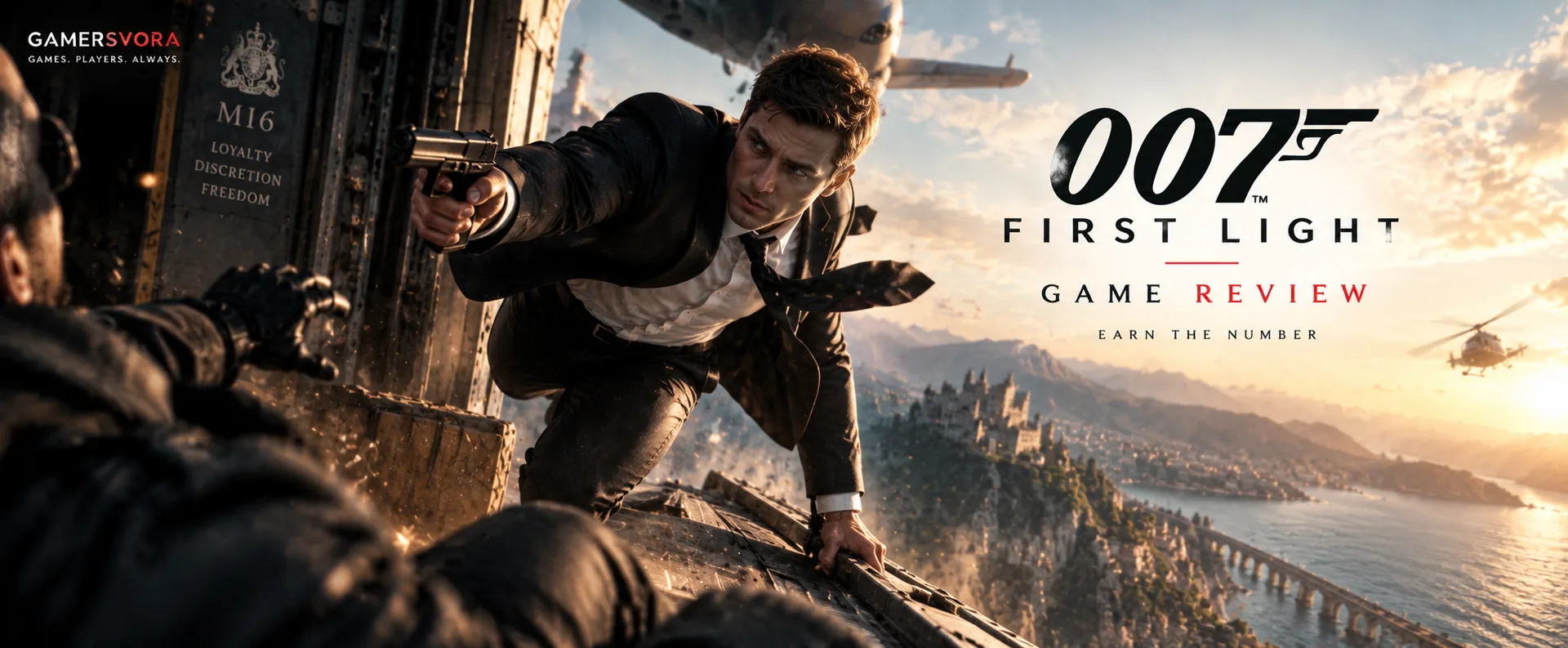
007 First Light mixes espionage, improvisation, gadgets and explosive action in an original James Bond origin story. More importantly, it understands that playing Bond should involve much more than simply pulling a trigger.
There was always an obvious reason to be interested in IO Interactive making a James Bond game.
The studio spent years turning Hitman’s Agent 47 into one of gaming’s most flexible problem-solvers. Give him a guarded building, a target and several seemingly unrelated opportunities, and the fun comes from deciding how those pieces fit together.
Bond needs something different.
James Bond shouldn’t feel like Agent 47 wearing a tuxedo. He needs the confidence to walk through the front door, the instinct to improvise when a plan collapses and enough action-movie swagger to turn a quiet infiltration into a car chase or firefight without either side feeling out of place.
That’s the challenge behind 007 First Light.
Developed and self-published by IO Interactive in collaboration with Amazon MGM Studios, First Light launched on May 27, 2026 for PlayStation 5, Xbox Series X|S and PC. Rather than adapting an existing Bond movie, IO built an original, reimagined origin story around a 26-year-old James Bond who hasn’t yet earned the number 007. citeturn0search11turn0search12
That younger Bond gives First Light something surprisingly useful: room to make mistakes.
Before the Tuxedo, Before the Martini, Before 007
This isn’t the polished Bond who walks into a casino already knowing he’s the most dangerous person in the room.
He’s getting there.
According to the official 007 First Light story introduction, Bond begins as a young Naval air crewman. An audacious act of bravery puts him on the path toward MI6 and its newly revived Double 0 programme.
He’s talented, resourceful and sometimes reckless — exactly the combination you’d expect from someone who will eventually become James Bond, but without decades of experience smoothing the rough edges.
That premise is more than an excuse for an origin story.
It also fits the way First Light wants players to approach missions.
Bond doesn’t always need the perfect plan. Sometimes he needs to recognise that the plan has already failed and find another one.
The later story brings him together with mentor John Greenway as the reappearance of rogue operative 009 becomes an early major test for the Double 0 programme. IO’s February 2026 official story trailer breakdown revealed a pursuit stretching from the Carpathian Mountains to the black market of Aleph, alongside the dangerous Bawma. citeturn0search10
It’s recognisable Bond territory — rogue agents, global conspiracies, MI6 politics, exotic locations and dangerous personalities — without being tied to a movie screenplay.
And that freedom matters.
First Light isn’t asking you to recreate Bond moments you’ve already watched.
It wants you to create some of your own.
The Real Hook Isn’t Shooting — It’s Choice
One idea sits underneath almost everything IO Interactive has shown and described about First Light:
Improvisation.
That’s probably the most important ingredient separating this from a conventional third-person action game.
During the extensive official 007 First Light gameplay deep dive, IO demonstrated missions involving infiltration, driving, stealth, gadgets and open combat. One sequence revolved around a covert operation at a high-stakes chess tournament in Slovakia; another took Bond into a lavish gala in Kensington. citeturn0search0
The environments aren’t simply corridors connecting firefights.
They’re problems.
And Bond has options for solving them.
An encounter might begin with observation. You identify a restricted area, watch guards and look for a route through.
Maybe you find one.
Maybe somebody notices you.
Now the situation changes.
Instead of immediately treating detection as failure, First Light gives Bond tools for recovering. He can bluff, manipulate people, use gadgets, fight at close range or eventually reach for a firearm.
That distinction could prove crucial.
In many stealth games, an alarm effectively means the elegant version of your plan is over. Reloading a checkpoint often feels more appropriate than fighting through the consequences.
Bond shouldn’t work like that.
Some of the best Bond sequences begin precisely when everything goes wrong.
Spycraft Gives Bond Something More Interesting Than Detective Vision
Gadgets were inevitable.
The interesting question was how IO would use them.
Q Branch technology isn’t simply there so First Light can tick another box on the James Bond checklist. Gadgets are intended to open routes and manipulate environments.
Bond can hack security systems, interfere with cameras, create distractions and use specialised tools to bypass obstacles. IO’s gameplay material demonstrates how these abilities sit alongside observation and environmental interaction rather than functioning purely as weapons. citeturn0search0
Then there’s Instinct.
Instead of serving only as a familiar “detective vision” system, Instinct operates as a resource Bond can spend to create situational advantages.
That includes distracting or manipulating characters, bluffing his way out of suspicious situations and gaining advantages when an encounter becomes violent.
It’s a clever interpretation of Bond.
Games have always found it easy to represent his shooting ability. Give the player a gun.
His driving ability? Give them a car.
His charisma is considerably harder.
Movies can simply show Bond talking his way past somebody. Games need to turn that quality into something the player can actually use.
Instinct provides one possible answer.
It essentially treats Bond’s composure, quick thinking and ability to manipulate a situation as another weapon.
If the full game consistently gives those interactions meaningful consequences, spycraft could become one of First Light’s most distinctive systems.
Then Someone Reaches for a Gun
Of course, diplomacy has limits.
First Light combines firearms with close-quarters combat rather than separating them into completely different gameplay states.
That makes sense for Bond.
He’s dangerous with a pistol, but some of the franchise’s most memorable fights are messy, physical encounters where furniture, walls and whatever happens to be nearby become part of the choreography.
The challenge is balance.
If shooting everyone becomes dramatically easier than infiltration, gadgets and bluffing, much of First Light’s espionage design becomes optional decoration.
Push too far in the opposite direction and “going loud” stops feeling like a legitimate Bond solution.
The ideal version allows failure to become improvisation.
You attempt the sophisticated approach. Something goes wrong. A guard becomes suspicious. The conversation doesn’t save you. Somebody reaches for a weapon.
Now you’re playing a completely different version of the same encounter.
That’s much more interesting than simply choosing “Stealth” or “Combat” from an invisible menu.
IO Interactive’s Hitman DNA Is Everywhere — And That’s Mostly Good
Comparisons with Hitman are unavoidable.
They are also useful, up to a point.
IO Interactive has spent decades designing spaces built around restricted areas, NPC routines, environmental opportunities, disguise mechanics and player improvisation.
Those skills make extraordinary sense for Bond.
But First Light can’t simply become Hitman with a younger protagonist and faster gunplay.
Bond’s fantasy is broader.
Cars matter.
Gadgets matter.
Hand-to-hand combat matters.
Spectacle matters.
So does walking into an impossibly expensive room and behaving as though you belong there.
First Light therefore combines focused narrative sequences with more open areas that provide greater freedom in how objectives are approached. IO specifically describes creativity and player agency as important parts of that structure. citeturn0search10
That’s an exciting combination.
It’s also one of the game’s biggest design risks.
Hitman’s systems work because IO gives them enormous room to breathe. A game simultaneously handling stealth, social manipulation, melee combat, shooting, driving and cinematic set pieces has considerably more moving pieces.
Variety isn’t automatically depth.
The important question isn’t how many things Bond can do.
It’s whether those things meaningfully connect.
Bond’s Age Actually Helps Explain the Gameplay
Making Bond 26 isn’t merely a narrative gimmick.
It helps explain why the game can move between careful espionage and spectacular recklessness without the character feeling inconsistent.
IO describes this Bond as talented but still learning when to fight, bluff or disappear. citeturn0search3
That’s almost a description of the player’s job.
You don’t begin as the finished 007.
You’re learning how to behave like him.
There’s room here for progression to mean something beyond larger damage numbers or another skill-tree percentage.
New gadgets, techniques and abilities can represent Bond becoming a better intelligence operative.
More importantly, mistakes make sense.
A younger Bond getting impatient, misreading a situation and having to improvise his way through the consequences feels consistent with the character IO is building.
Players already know where the journey eventually leads.
The interesting part is discovering what happens before he gets there.
First Light Understands That Bond Needs Spectacle
Systemic gameplay alone isn’t enough.
A Bond game needs moments where subtlety goes out the window.
The 30-minute gameplay presentation demonstrated that IO understands this. The footage moves between espionage and larger action sequences rather than treating the entire game as one extended infiltration sandbox. citeturn0search0
Driving is part of that equation.
So are cinematic sequences that place Bond in situations considerably larger than anything you’d normally encounter during a Hitman contract.
That’s important because Bond exists somewhere between spy fiction and action fantasy.
Too much stealth and he becomes Agent 47.
Too much gunfire and he becomes another third-person action hero.
First Light has to live between those extremes.
The Glacier engine — IO Interactive’s proprietary technology — powers the experience, and the environments shown publicly emphasise detailed locations, crowds, character animation and cinematic transitions. The engine and game’s blend of combat, driving, stealth and gadgets were confirmed when IO originally unveiled the project. citeturn0search3
The visual contrast is particularly appropriate for Bond.
A glamorous gala can also be an infiltration environment.
A beautiful European location can become dangerous.
An elegant conversation can be followed five minutes later by a brutal fight.
That tension between sophistication and violence has always been part of Bond’s appeal.
Mission Replayability Could Be a Major Strength
One of IO Interactive’s biggest advantages is understanding that a mission doesn’t necessarily need to reveal everything during the first playthrough.
First Light appears to carry some of that philosophy forward.
When environments support multiple approaches, returning to them can expose routes, interactions and opportunities that weren’t obvious the first time.
That’s fundamentally different from a heavily scripted action game where the second playthrough largely asks you to repeat the same spectacle.
The interesting question is how far First Light pushes this idea.
If different approaches genuinely alter how missions unfold, replayability could become one of its strongest qualities.
If those choices merely provide three slightly different routes to the same scripted encounter, the promise becomes less exciting.
This is precisely where IO’s experience gives First Light reason for optimism.
It’s a Single-Player Bond Adventure
Anyone hoping First Light would revive the competitive multiplayer legacy associated with older Bond games should adjust expectations.
IO Interactive’s official First Light FAQ confirms that the game does not include an online or multiplayer experience. The studio says its focus is on building the single-player experience. citeturn0search11
For this particular game, that’s understandable.
First Light is trying to combine narrative progression, environmental problem-solving, espionage, gadgets and cinematic action.
A multiplayer mode would be an entirely different design challenge.
This game seems much more interested in letting you be Bond than putting Bond-themed weapons into an online arena.
Platforms and Technical Features
007 First Light launched on May 27, 2026 for PlayStation 5, Xbox Series X|S and PC. IO’s FAQ lists Nintendo Switch 2 separately for summer 2026. citeturn0search11
The game is available through the official PlayStation 5 page, while PC players can access the release through supported PC storefronts documented by IO Interactive. citeturn0search12turn0search15
PS5 Pro receives additional treatment. IO Interactive documented the use of upgraded PlayStation Spectral Super Resolution on Sony’s higher-end console, with the technology aimed at producing a cleaner and more stable reconstructed image. IO’s PS5 Pro technical breakdown goes into considerably more detail about the implementation. citeturn0search5
Official support documentation also lists launch installation sizes of approximately 50.8GB on PS5, 58.7GB on Xbox and 53.2GB on PC/Steam, including the Day 1 patch. citeturn0search15
Those specifications shouldn’t be mistaken for a GamersVora performance verdict.
Frame pacing, bugs, image quality and actual performance need to be tested on the individual platform before making those judgments.
Is 007 First Light Worth Your Attention?
There’s an important difference between making a good action game with James Bond in it and making a game that actually understands why people want to play as James Bond.
First Light’s design suggests IO Interactive understands that distinction.
Bond isn’t interesting simply because he’s allowed to shoot people.
It’s everything surrounding the gunfight.
Walking into somewhere you shouldn’t be.
Reading the room.
Bluffing.
Finding another entrance.
Using a gadget.
Getting caught.
Trying to recover.
Failing spectacularly.
Throwing a punch.
Taking someone’s weapon.
Stealing a car.
And somehow reaching the end of the mission looking as though the entire disaster was intentional.
That’s Bond.
IO Interactive’s systemic-design experience makes it an unusually appropriate studio for that fantasy. First Light then stretches beyond Hitman’s deliberate assassination sandboxes with more direct combat, driving and cinematic spectacle.
There is risk in trying to do all of those things simultaneously.
But there’s also considerable potential.
First Light doesn’t need to be Hitman with a licence to kill.
It needs to make players feel like they earned the number.
And from the design philosophy behind it, that’s clearly what IO Interactive set out to achieve.
GamersVora Verdict
007 First Light has one particularly compelling idea: being James Bond should involve more than shooting accurately. IO Interactive has built its interpretation around infiltration, observation, gadgets, bluffing, close combat, firearms, driving and improvisation, while the younger Bond premise gives those systems a narrative reason to coexist. The studio’s Hitman experience makes it an unusually natural fit for 007, although combining so many different gameplay styles creates its own design challenges.
GamersVora has not independently completed a review playthrough, so we’re withholding a numerical rating rather than turning external research into a false firsthand verdict.
GamersVora Rating: Not Scored — independent GamersVora playtesting required.



Sign in to Comment
Join the Gamersvora community
Create a free account or sign in to comment and reply. This keeps conversations safer and reduces spam.