
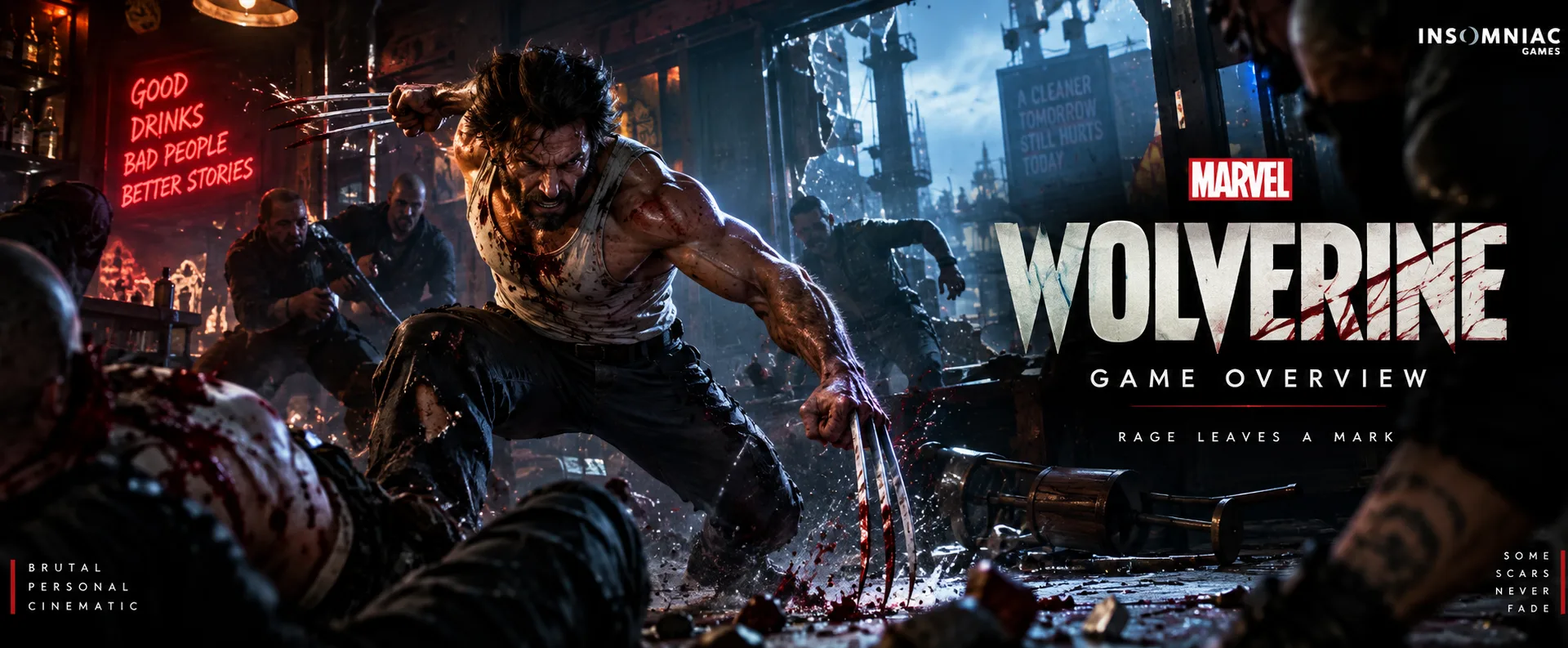
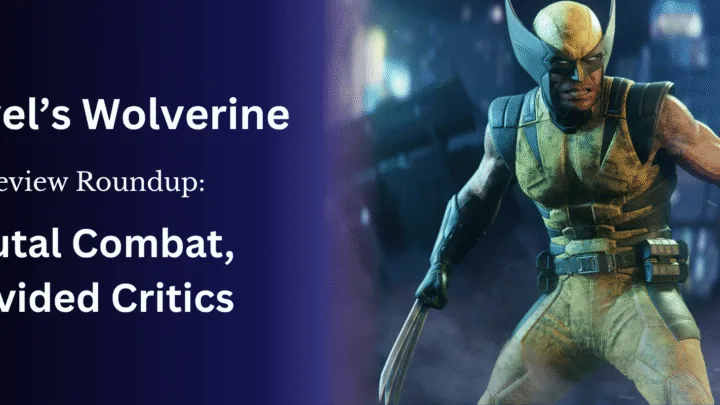
Five minutes of watching Marvel’s Wolverine in action tells you almost everything about how far Insomniac wanted to get from Spider-Man.
Peter Parker bounces. Logan barrels forward.
Enemies aren’t wrapped neatly in webs and left for the authorities; claws go through bodies, limbs come off, blood stains the floor, and Logan himself can be torn apart before his healing factor starts putting him back together. Insomniac hasn’t tried to make its Wolverine comfortable simply because its Spider-Man games reached a huge audience.
That commitment isn’t really where critics disagree.
The argument surrounding Marvel’s Wolverine, which arrived on PS5 on September 15, is whether the thrill of finally being given an appropriately savage Wolverine is enough to carry a tightly directed action game whose combat, according to some reviewers, starts showing its limits sooner than expected.
That’s a much more interesting conversation than the score alone.
GamersVora hasn’t completed a review playthrough, so we’re not attaching our own rating to the game. Instead, we’ve gone through the early critical response alongside Insomniac and PlayStation’s official material to separate the points critics broadly agree on from the areas where opinions split sharply.
And they do split.
Insomniac hasn’t made Spider-Man with claws
The obvious comparison was always going to be Spider-Man. Same developer, another Marvel hero, another expensive PlayStation exclusive.
It turns out to be a slightly misleading one.
Marvel’s Wolverine isn’t built around a giant city waiting to be cleared district by district. Insomniac describes it as a single-player, narrative-driven action-adventure, and the campaign sends Logan through places including Canada, Japan and Madripoor rather than handing him one enormous open world.
For anyone arriving directly from Spider-Man 2, that changes the rhythm immediately.
There’s no equivalent of swinging across Manhattan and spotting three distractions on the way to the next mission. Wolverine is much happier pushing you forward, occasionally giving you room to search for resources, suits or optional challenges before returning to the story.
Some critics have welcomed that restraint.
The current critical discussion around the game is interesting partly because linearity itself isn’t necessarily the complaint. A focused action campaign can be exactly what a character like Logan needs. The trouble comes if the fighting occupying so much of that campaign isn’t changing quickly enough.
That’s where reviews become much less unanimous.
Logan is arguably the easiest part to get behind
Insomniac’s version of Wolverine is played by Liam McIntyre, and this isn’t a story about Logan meeting Professor X and joining the X-Men.
He has already lived through some ugly history.
Three years after leaving Team X, Logan is dragged back toward that world as Bolivar Trask begins hunting mutants. Sabretooth and Mystique are involved, old memories refuse to stay buried, and the journey eventually stretches far beyond its initial conflict.
Insomniac’s official story and gameplay presentation made clear before launch that the studio wasn’t interested in sanding down Logan’s personality. He’s angry, damaged and capable of frightening violence, but the character isn’t being reduced to an endless sequence of growls and executions either.
This is one of the areas where even harsher reviews have found something worthwhile.
The Guardian’s Keith Stuart, who was considerably less impressed by the fighting, still praised McIntyre’s Logan and found substance in his relationships with characters such as Sabretooth and Jean Grey. citeturn0news0
That matters more than it might sound.
A Wolverine game can sell its first trailer with claws and gore. Keeping Logan interesting between those fights requires something else.
Insomniac seems much more confident there.
Then the claws come out
Combat begins with a wonderfully simple premise: Wolverine doesn’t want space between himself and the enemy.
He wants it gone.
Logan can leap into opponents, shred them with repeated claw attacks, dodge, parry and chain techniques together while Rage builds through successful aggression. Insomniac’s game-features breakdown also details Techniques and Adaptations that expand his options as the campaign progresses.
Rage is particularly well suited to the character.
The meter has three stages, progressively increasing Logan’s offensive and defensive capability until he becomes extraordinarily difficult to stop. His famous Healing Factor isn’t relegated to a cutscene explanation either; it feeds directly into survival, including a Last Stand mechanic when things go badly.
On paper, those systems fit Wolverine almost perfectly.
And initially, according to much of the coverage, the fighting can be enormously satisfying.
The problem is longevity.
The Guardian’s review describes a system in which dodging, parrying and linking shred attacks remained effective through a large portion of the game. New abilities arrived, but the encounters didn’t consistently force the reviewer to rethink that basic approach. Bosses suffered from a similar problem. citeturn0news0
That’s a serious criticism for a game built this heavily around close-quarters combat.
A spectacular execution is spectacular the first time.
By the twentieth, the player needs another reason to care.
Violence gives Wolverine personality. Depth has to come from somewhere else.
There is no ambiguity about what those adamantium claws do.
Wolverine is dramatically more graphic than Insomniac’s Spider-Man games. Attacks can sever limbs, blood is plentiful, and Logan’s own injuries can expose the metal underneath before his body repairs itself.
It looks vicious because it should.
Even pre-release coverage picked up on how heavily Insomniac leaned into this distinction. An August hands-on from The Guardian noted both the technical detail of the dynamic damage and the way DualSense feedback reinforces individual impacts, while questioning whether all of that visual violence translated into enough mechanical weight. citeturn0search5
That’s a useful way to frame the debate.
Gore can sell the fantasy of Wolverine. It can’t provide the depth of an entire combat system.
Games such as Devil May Cry and Bayonetta keep melee combat alive by asking players to master increasingly complicated interactions. Batman: Arkham built a different sort of rhythm around crowd management and counters. Wolverine doesn’t need to copy any of them, but the more enemies the campaign throws at Logan, the more its own systems need to justify another fight.
Critics appear divided on whether they do.
The Healing Factor is more interesting than simply giving Logan a large health bar
Wolverine presents an unusual design headache.
How do you threaten a superhero famous for being almost impossible to kill?
Making him fragile would feel wrong. Making him effectively immortal would destroy the tension.
Insomniac’s answer is to make regeneration part of the fighting rather than pretend it doesn’t exist.
Damage can leave Logan visibly mangled. His body repairs itself. Rage and Healing Factor mechanics encourage the player to keep pushing rather than retreating to safety every time health gets low.
It’s a smart interpretation of the character because Wolverine shouldn’t fight like someone terrified of being hit.
His recklessness is part of the appeal.
It also helps distinguish him mechanically from Spider-Man. Peter survives by avoiding attacks and controlling space. Logan can absorb punishment and turn an ugly exchange into an advantage.
Whether the surrounding encounters demand enough sophistication is another matter, but the underlying idea feels specifically built for Wolverine rather than imported from another Insomniac game.
A smaller world might actually be one of Wolverine’s better decisions
There was an almost automatic reaction when Insomniac confirmed that Wolverine wasn’t open world: Why not?
I’m not convinced bigger would have solved anything critics are complaining about.
The campaign already moves through Canada, Japan and Madripoor. Keeping those locations discrete gives the studio freedom to change scenery, atmosphere and pacing without connecting everything through miles of traversal.
More importantly, Logan isn’t Spider-Man.
Peter Parker’s movement makes crossing New York entertaining in itself. Swinging to the next objective is part of the game.
Wolverine would need a different reason for players to enjoy crossing an enormous map.
Without one, a larger world could simply have meant more distance between fights.
The tighter structure has its own risks, though. When there are fewer side systems competing for attention, weak repetition becomes easier to see. An open world can distract you for half an hour. A linear action game has nowhere to hide when its next encounter resembles the previous five.
The Verge’s coverage has been notably more receptive to this old-fashioned, direct style of action game, while other reviewers have found the limited exploration restrictive. That disagreement says more about Wolverine than a simple argument over whether open worlds are good or bad.
The structure isn’t inherently a flaw.
It simply puts enormous pressure on the combat and story.
Madripoor, Canada and Japan give the campaign room to change its scenery
One benefit of the globe-trotting setup is that Logan isn’t trapped inside one visual identity for the entire game.
The official PlayStation page highlights locations stretching from the Canadian wilderness to Japan and Madripoor, Marvel’s notorious criminal haven.
Madripoor in particular feels made for him.
It’s dirty, dangerous and morally flexible, a place where Logan’s history fits more naturally than it would against another gleaming superhero skyline.
Exploration exists within these locations, but it isn’t the point. Optional combat trials, resources and unlockable suits provide reasons to look around without turning every environment into a checklist.
Players who measure value by map size may find the approach thin.
Players exhausted by enormous maps may find it merciful.
The bosses expose the same argument as the regular combat
Boss fights ought to be where Wolverine’s mechanics are pushed hardest.
They’re also one of the areas attracting criticism.
Without getting into spoiler territory, the complaint isn’t necessarily that these encounters lack spectacle. Insomniac knows how to stage an expensive superhero confrontation.
The concern is that some bosses demand greater patience and timing without fundamentally changing what the player has already been doing.
That’s an important difference.
More health doesn’t automatically create more depth.
A memorable boss should expose something about the combat system the player hasn’t fully understood yet. It might alter spacing, punish an overused habit or make an ignored ability suddenly essential.
When the solution remains largely familiar but takes longer to execute, spectacle starts doing the work mechanics should be doing.
For players who primarily want to see Wolverine collide with familiar Marvel threats, that may be enough.
Action-game enthusiasts are likely to judge those encounters more harshly.
It certainly doesn’t look cheap
Whatever else people make of Wolverine, Insomniac hasn’t delivered something that looks like a side project.
Character models are exceptionally detailed, injuries transform Logan’s body in real time, animation sells the aggression of his attacks, and the campaign repeatedly shifts into large cinematic sequences.
This is unmistakably one of Sony’s major PS5 productions.
The game is also PS5 Pro Enhanced, with PlayStation listing support for PSSR on compatible hardware. DualSense haptics and adaptive triggers are used as part of the presentation, and 3D audio support adds another layer for compatible setups.
None of those features fixes repetitive encounter design.
They do matter to the overall experience, though, especially in a game that relies so heavily on physical impact.
A Wolverine attack needs to look painful.
It needs to sound painful.
Ideally, through the controller, it should even feel a little painful.
Insomniac clearly understood that assignment.
Don’t assume this is suitable for someone because they played Spider-Man
Parents should pay particular attention here.
The Indian PlayStation Store listing carries an IARC 18+ classification and identifies extreme violence and strong language among its content descriptors.
That rating isn’t surprising once you’ve seen the game.
Spider-Man and Wolverine may share a developer and Marvel branding, but they’re aimed at different audiences. Wolverine doesn’t conveniently hide the consequences of using six metal blades on another human being.
For adult fans who have spent years wanting a Wolverine game willing to embrace that side of the character, this is arguably overdue.
For a younger Spider-Man fan, it’s a completely different proposition.
Accessibility deserves more than a footnote
Insomniac has also carried forward one of the strongest aspects of its recent work.
PlayStation lists 35 accessibility features, covering visual, auditory, motor and cognitive needs.
That’s easy to bury underneath conversations about frame rates, review averages and gore, but for some players it determines whether Wolverine is playable at all.
Accessibility isn’t extra polish for those players.
It’s access to the game.
So, what’s actually going on with the reviews?
The early response isn’t the disaster that some social-media posts would have you believe.
Nor is it the kind of near-unanimous praise that followed several of Insomniac’s previous releases.
PC Gamer’s roundup characterized the response as good rather than great, reflecting the broader discussion around a game that entered review week with unusually high expectations. citeturn0news7
The Guardian sits toward the more critical end. Its review likes Logan, his relationships and portions of the story but argues that fighting increasingly turns into a chore. citeturn0news0
Other critics have been more enthusiastic about the same qualities that some find limiting: the direct campaign, old-school action-game structure and unapologetic violence.
Those aren’t tiny disagreements over whether a particular side quest is boring.
They’re disagreements about the thing Wolverine spends most of its time doing.
If the aggression, executions and steady flow of new abilities keep the combat exciting for you, a focused campaign with little open-world padding may be exactly what you wanted.
If you’re looking for a melee system that keeps demanding new levels of mastery, the criticism about repetition becomes much harder to ignore.
About that Metacritic number
There’s another reason not to reduce the conversation to one score yet.
Several outlets have reported an aggregate in the high 70s during the review period. PC Gamer, for example, discussed the game in that context when surveying the initial reviews. citeturn0news7
Aggregates can move as additional reviews are added, particularly around launch, so GamersVora isn’t going to pretend a fluctuating launch-week figure is permanent.
More useful than whether the number eventually settles at 77, 78 or somewhere nearby is why reviewers aren’t landing in the same place.
There is considerable appreciation for Logan himself, the production values and Insomniac’s willingness to make a focused, violent Wolverine game.
Combat longevity is where the conversation becomes much less comfortable.
Should you buy Marvel’s Wolverine?
If you’ve spent years wanting a Wolverine game where the claws aren’t treated like blunt instruments, this is probably the closest modern games have come to delivering that fantasy at blockbuster scale.
Insomniac hasn’t confused Logan with Spider-Man.
That’s a bigger achievement than it sounds.
The game is violent without apology, the campaign stays focused, Logan appears to carry genuine dramatic weight, and the globe-trotting structure avoids stretching one location across dozens of hours.
The warning from the reviews is equally straightforward.
Don’t assume brutality automatically means combat depth.
Players who need every ten hours of an action game to reveal another mechanical layer may find Wolverine too comfortable with its basic rhythm. Players who value a shorter, cinematic campaign and simply want Logan turned loose against Marvel villains may have a very different reaction.
That makes the current critical response less contradictory than it initially appears.
Reviewers aren’t really arguing over whether Insomniac made a convincing Wolverine.
For the most part, it seems they think it did.
They’re arguing over whether being Wolverine remains as exciting in hour ten as it is when those claws first come out.
For a game built around a character famous for saying he’s the best there is at what he does, that’s a pretty important distinction.

Sign in to Comment
Join the Gamersvora community
Create a free account or sign in to comment and reply. This keeps conversations safer and reduces spam.