
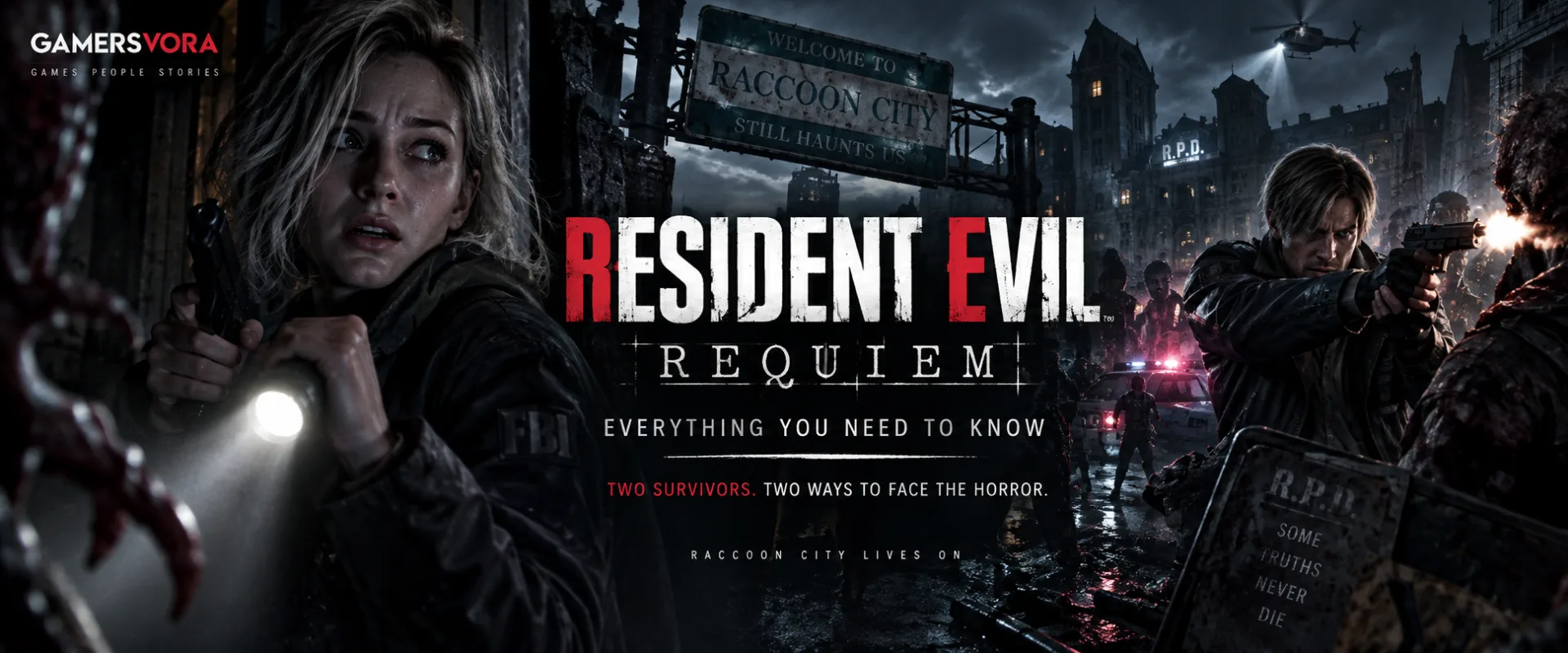
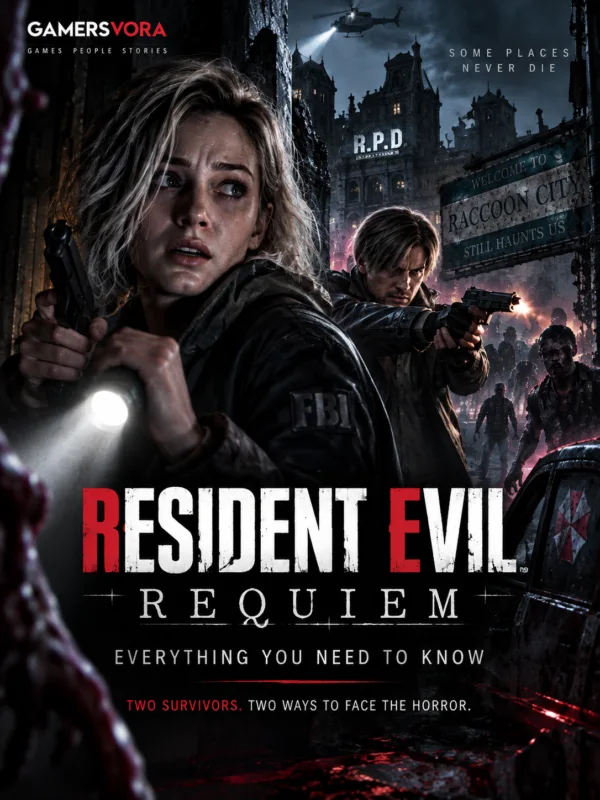
Raccoon City has been dead for a long time. Resident Evil, however, has never really escaped it.
Over the years, Resident Evil has moved through remote settlements, research sites, ruined cities and places where walking through the wrong door usually leads to something unpleasant. It has introduced new viruses, new organizations and new protagonists. Yet the events of 1998 still sit underneath much of Resident Evil like an old wound that never completely closed.
Resident Evil Requiem makes that connection impossible to ignore.
The ninth mainline Resident Evil game brings players back to the remains of Raccoon City, but Capcom has not simply rebuilt an old setting for another nostalgia trip. Requiem connects the city’s past to two characters standing at completely different points in their relationship with biological horror.
One is Grace Ashcroft, an FBI intelligence analyst who is intelligent and capable but thoroughly inexperienced when a normal investigation turns into something much worse.
The other is Leon S. Kennedy.
Leon does not need an introduction to longtime Resident Evil players. He survived Raccoon City as a rookie police officer, became a government agent, fought through multiple biological disasters and somehow kept walking into situations where ordinary firearms seemed increasingly inadequate.
Putting Grace and Leon in the same game gives Requiem its most interesting idea: survival horror does not have to feel the same depending on who is doing the surviving.
Resident Evil Requiem at a glance
| Detail | Information |
|---|---|
| Developer | Capcom |
| Publisher | Capcom |
| Director | Koshi Nakanishi |
| Release Date | February 27, 2026 |
| Platforms | PlayStation 5, Xbox Series X|S, PC, Nintendo Switch 2 |
| Genre | Survival Horror / Action |
| Engine | RE Engine |
| Playable Protagonists | Grace Ashcroft and Leon S. Kennedy |
| Perspective | Switchable first-person and third-person |
| Mode | Single-player |
That basic information only explains what Requiem is technically. Its identity comes from how differently the game treats its two protagonists.
Grace Ashcroft Experiences This Nightmare Without a Veteran’s Advantage
Resident Evil has a problem created by its own history.
Its famous protagonists are becoming extremely difficult to frighten.
Chris Redfield has fought biological weapons for decades. Leon has survived everything from zombies and parasites to heavily armed bio-terrorists. Jill Valentine has already escaped the Spencer Mansion, Raccoon City and Nemesis. Put one of these characters in a dark corridor and the audience may be nervous, but the character usually knows exactly what kind of nightmare is waiting.
Grace Ashcroft gives Capcom another option.
She works for the FBI and is particularly skilled at analysis and investigation, but she is not an experienced monster hunter. Darkness unsettles her. Unexpected threats shake her. Her physical reactions communicate something that the series cannot easily achieve with its veteran heroes anymore: uncertainty.
That vulnerability is not simply part of her personality. It feeds directly into the way her sections are designed.
Grace has tighter inventory restrictions and fewer resources to waste. Ammunition matters. Fighting every infected creature is not automatically the smartest decision. Sometimes an enemy is an obstacle to remove. Sometimes it is something to study, distract or avoid.
That brings Requiem closer to one of survival horror’s most important questions:
Do I really want to spend ammunition on this?
It sounds simple, but that decision is responsible for much of the tension in classic Resident Evil. A corridor becomes dangerous not just because something is inside it, but because killing that something may leave you unprepared for whatever is behind the next door.
Grace’s gameplay is built to keep that calculation alive.
Grace has an unusual answer to the resource problem: blood
Requiem also gives Grace a crafting system tied directly to infected blood.
Blood collected from infected enemies and certain areas can be used as crafting material. Grace can turn those resources into useful supplies including ammunition and specialized injectors.
It creates an interesting risk-and-reward relationship with enemies.
Ordinarily, a resource-starved character has every reason to avoid unnecessary combat. Requiem complicates that logic because defeating or approaching infected creatures may also give Grace access to materials that help her survive later encounters.
That means an enemy is not simply a threat.
It may also be a resource.
The result fits Grace’s character particularly well. Leon often solves a dangerous situation through experience and firepower. Grace is more likely to survive because she has observed the environment, understood what she has available and found a less obvious solution.
For a character introduced as an analyst, that distinction makes sense.
Then Leon walks in and changes the entire temperature of the game
Grace may spend precious seconds considering whether engaging an enemy is worth the ammunition.
Leon S. Kennedy has a hatchet.
That tells you quite a lot about the difference.
Leon’s Requiem gameplay draws heavily on the more combat-focused side of modern Resident Evil. He carries multiple firearms, manages equipment through an attaché-style inventory and can improve weapons with upgrade parts.
He can fight at close range, perform melee attacks, parry incoming blows and use his hatchet for brutal finishes. Enemy weapons can even become opportunities rather than simply threats; chainsaws are not exclusively something Leon has to run away from.
That does not turn Requiem into a pure action game whenever Leon appears. Ammunition, positioning and enemy management still matter.
The important difference is confidence.
Grace enters dangerous spaces trying to understand how she is going to get through them.
Leon enters those spaces with nearly three decades of biological disasters behind him.
The same creature can therefore create two completely different emotions depending on which character is standing in front of it.
Leon returning to Raccoon City matters more than another familiar face
There would have been an easy version of Leon’s return: bring back a hugely popular character, give him a few memorable one-liners and let nostalgia handle the rest.
Raccoon City makes that approach harder.
For Leon, this is where everything started.
He arrived there as a rookie police officer expecting his first day on the job and instead found a city collapsing around him. He survived, but that survival determined almost everything that followed. Government work, bioterror investigations and years of encountering increasingly horrific consequences of biological weapons all trace back to that first night.
Requiem’s Leon is therefore not the inexperienced officer from Resident Evil 2 or even exactly the agent seen during Resident Evil 4.
He is older.
More experienced.
And carrying considerably more history.
Capcom has described that accumulated loss as an important part of the character this time. That gives the return to Raccoon City a purpose beyond recognizing old landmarks.
Grace is discovering what this world actually is.
Leon is returning to where it changed his life.
Those perspectives create a much stronger reason to revisit the city than nostalgia alone.
The Ashcroft name creates another connection to 1998
Grace also carries her own link to Raccoon City’s history.
Her mother is Alyssa Ashcroft, the investigative journalist Resident Evil fans may remember from Resident Evil Outbreak.
Alyssa survived the Raccoon City disaster and continued investigating the truth surrounding Umbrella afterward. Years later, her death became a defining event in Grace’s life.
Requiem’s investigation sends Grace toward the abandoned Wrenwood Hotel, the place connected to her mother’s murder, while a mysterious series of deaths begins pulling old history into the present.
That choice gives Grace a useful position within the wider franchise.
New players do not need decades of Resident Evil knowledge to understand her. She begins from a relatively ordinary perspective and learns about the significance of past events as the story develops.
Longtime players, meanwhile, will recognize immediately that the Ashcroft name is not accidental.
It allows Requiem to dig into old Resident Evil history without making its new protagonist another returning super-soldier.
Requiem’s zombies have not completely forgotten being human
One of the more interesting changes involves enemies that would normally be considered Resident Evil’s most familiar threat.
Zombies are difficult to make mysterious after decades of games, films and television. Everyone understands the broad rules. They shuffle, they bite, and shooting them in the head usually sounds like a reasonable plan.
Requiem tries to make them less predictable by leaving fragments of former human behavior behind.
Some infected continue repeating activities connected to who they were before infection. Others react to environmental conditions or make use of objects and weapons around them.
That changes exploration in a subtle but important way.
Instead of immediately asking, “How many bullets will this zombie require?”, the player has another option: watch it.
What is it doing?
What attracts it?
Can it be moved somewhere else?
Is there a safer route?
For Grace especially, observation can become another form of ammunition.
It also makes the infected more disturbing. A mindless corpse is frightening in one way. A creature still performing a distorted version of something it once did as a human is frightening for an entirely different reason.
First-person or third-person is now the player’s decision
Resident Evil’s camera perspective has changed dramatically across different eras.
Resident Evil 4 pushed the series toward over-the-shoulder third-person action. Resident Evil 7 later moved directly into first-person horror, putting enemies uncomfortably close to the player’s face. Village continued that approach before eventually gaining a third-person option.
Requiem stops asking players to choose between those eras.
Both Grace and Leon can be played in either first-person or third-person, with the perspective switch available according to player preference.
It is more than an accessibility convenience.
First-person naturally reduces spatial awareness and pushes the player closer to every sound, doorway and enemy.
Third-person provides more information about the space around the character, while also allowing players to watch Grace or Leon physically react to situations.
The characters themselves even help make those perspectives feel different. Grace does not handle a firearm with the same calmness as Leon. Her lack of combat experience is visible in the way she responds to danger.
Players who enjoy replaying Resident Evil games therefore have another reason to experiment. A section approached in third-person may feel surprisingly different when revisited through Grace’s eyes.
The two campaigns are not completely isolated from each other
One of Requiem’s smartest ideas is that Grace and Leon are not simply two disconnected characters whose chapters happen to share a title screen.
Their paths overlap.
In locations visited by both protagonists, actions can persist. An enemy dealt with earlier may remain dealt with when control later shifts. Items left behind can also affect what is available during another section.
That creates possibilities beyond the immediate moment.
Grace may be capable of killing an infected creature, but spending significant ammunition to do so might be wasteful if Leon will later pass through the same area with a far stronger arsenal.
Run now. Deal with it later.
For a survival horror game, that is an interesting extension of resource management. The player is not always managing supplies for the character currently on screen; knowledge of how the two play can influence decisions across the larger journey.
It also reinforces the central contrast.
A monster that represents a major problem for Grace may become unfinished business for Leon.
Raccoon City is being treated as a scar rather than a museum
The return to Raccoon City could easily have become an excuse to reconstruct familiar streets and ask players to point at things they remember.
Requiem takes a more interesting route by dealing with the city as a damaged place.
This is not Raccoon City on the night of the outbreak. The catastrophe is history now. The ruins left behind carry decades of absence, destruction and unanswered questions.
That passage of time is important.
For Grace, Raccoon City belongs partly to her mother’s story.
For Leon, it belongs to his own.
For the wider Resident Evil universe, it remains the event that exposed just how catastrophic Umbrella’s experiments had become.
A city destroyed decades earlier still shaping the lives of people in the present is a much stronger idea than simply returning because fans recognize the name.
The word Requiem feels appropriate because the game is surrounded by people and places trying, in different ways, to deal with the dead.
Modern technology is serving an old survival-horror idea
Requiem continues to use Capcom’s RE Engine, which has powered the publisher’s modern Resident Evil games.
The technical improvements are easy to focus on: detailed faces, lighting, dense environments and the increasingly unpleasant amount of detail Capcom can put into infected bodies.
But graphical fidelity is most useful to horror when it serves atmosphere rather than spectacle.
A character’s breathing matters.
A distant movement matters.
The texture of a corridor matters when the player is moving through it slowly because only six bullets remain.
That is where Requiem’s technology and its survival-horror design meet. The goal is not simply to produce more realistic monsters. It is to make the space around those monsters convincing enough that entering it feels uncomfortable.
On PC, Capcom lists Windows 11 and 16GB of RAM for both the minimum and recommended configurations. The minimum GPU specification includes a GeForce GTX 1660 6GB or Radeon RX 5500 XT 8GB, while the recommended tier moves to a GeForce RTX 2060 Super 8GB or Radeon RX 6600 8GB. An SSD is required.
The game is also available on PlayStation 5, Xbox Series X|S and Nintendo Switch 2, with no PlayStation 4 or Xbox One release.
Requiem is trying to reconcile two versions of Resident Evil
Resident Evil has spent much of its life moving between two extremes.
One side is slow, uncomfortable survival horror: small inventories, locked doors, puzzles, limited ammunition and enemies you may prefer not to fight.
The other is combat-driven Resident Evil: powerful weapons, aggressive encounters, melee attacks and protagonists experienced enough to stand their ground.
Fans sometimes discuss those approaches as though the franchise needs to choose one.
Requiem’s answer is more interesting.
Why choose?
Grace can carry the vulnerability.
Leon can carry the power.
And because their stories intersect, the game can move between those emotions without pretending the characters should respond to danger in exactly the same way.
A frightened FBI analyst and a veteran government agent should not experience a zombie outbreak identically.
Requiem builds around that difference instead of hiding it.
A return to Raccoon City that looks forward as much as backward
Leon being back will understandably dominate a lot of attention. Few characters are as closely associated with Resident Evil, and bringing him into the ruins of Raccoon City immediately gives Requiem enormous historical weight.
But Grace may be just as important to what Capcom is trying to do.
Leon represents everything Resident Evil has accumulated over nearly three decades: experience, history, scars and familiarity with horrors that once seemed impossible.
Grace represents what those horrors feel like when they are still new.
Put them together and Requiem becomes more than a story about returning to an old city.
It becomes a story about two different ways of surviving the same nightmare.
One character walks through the darkness wondering whether she has enough ammunition to make it out.
The other has been walking through that darkness since 1998.
And waiting behind both of them is Raccoon City — destroyed, remembered, and apparently still not finished with the people who survived it.


Sign in to Comment
Join the Gamersvora community
Create a free account or sign in to comment and reply. This keeps conversations safer and reduces spam.