
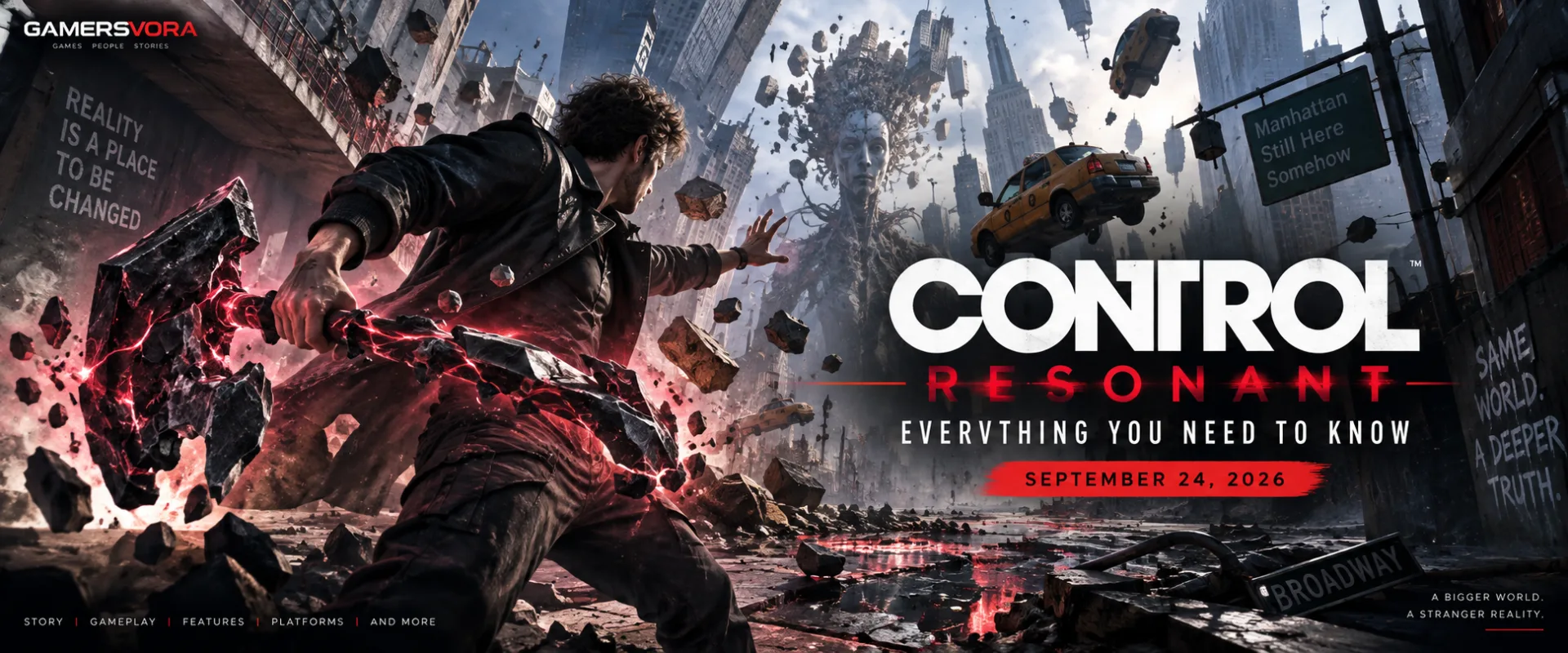
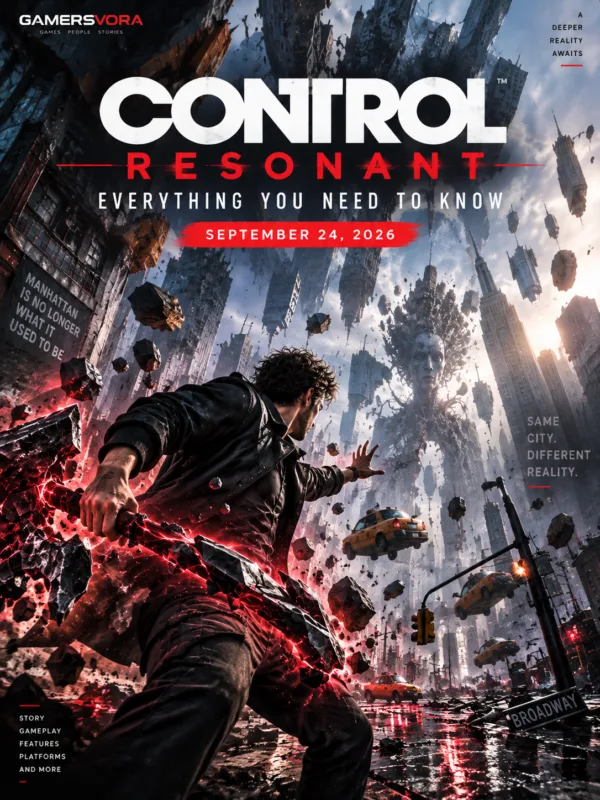
CONTROL never felt like a game that needed to become bigger just for the sake of it.
The strange halls of the Oldest House were a huge part of its identity. You could walk through an ordinary-looking doorway and suddenly find yourself somewhere that seemed to ignore every rule the building had established five minutes earlier. That contained weirdness worked.
CONTROL Resonant is taking a much riskier approach.
Remedy Entertainment is moving the paranormal disaster beyond the walls of the Federal Bureau of Control and into Manhattan. Jesse Faden is no longer the character we play. Guns are no longer the obvious centre of combat. And the tightly packed spaces of the first game are being replaced by much larger areas built around exploration, traversal and character progression.
That makes Resonant more than a straightforward sequel. Remedy appears to be changing several of CONTROL’s foundations while keeping the part that mattered most: a world where reality can stop making sense at any moment.
With release only days away, here is what you should know before CONTROL Resonant arrives on September 24, 2026.
CONTROL Resonant at a glance
| Detail | Information |
| Release date | September 24, 2026 |
| Developer | Remedy Entertainment |
| Publisher | Remedy Entertainment |
| Genre | Action-adventure RPG |
| Platforms at launch | PlayStation 5, Xbox Series X|S, PC |
| PC stores | Steam, Epic Games Store |
| Cloud gaming | GeForce NOW |
| Mac | Planned for later in 2026 |
| Main character | Dylan Faden |
| Game mode | Single-player |
| Main story length | Roughly 25–35 hours |
| Setting | A paranaturally altered Manhattan |
This time, the problem has escaped the Oldest House
The first CONTROL introduced Jesse Faden as she entered the Federal Bureau of Control looking for answers about her missing brother, Dylan.
Resonant flips that relationship.
Dylan is now at the centre of the story, while Jesse is missing.
Years of confinement by the FBC have left Dylan with more than a complicated relationship with the Bureau. He emerges into a Manhattan being torn apart by a paranatural catastrophe, with familiar threats such as the Hiss and the Mold no longer safely contained inside the Oldest House.
There is also something new at work.
A larger cosmic threat is altering the city itself, pushing Manhattan further away from anything resembling normal reality.
That change in location matters because Remedy is no longer asking what happens when something impossible is trapped inside a secret government building. Resonant asks what happens when containment fails completely.
Streets, buildings and entire sections of the city can now become part of the supernatural event.
That should give Remedy much more room to experiment.
The Oldest House was strange because you never completely understood what might be behind the next door. Manhattan gives the studio an opportunity to take that same uncertainty and apply it to a far larger space.
Dylan Faden is not simply Jesse with a different face
Changing protagonists could easily have been cosmetic. Everything Remedy has shown so far suggests it is doing considerably more than that.
Dylan’s history is different.
His relationship with the FBC is different.
And most importantly, the way he fights is different.
Jesse’s Service Weapon defined a large part of CONTROL’s combat. Telekinesis gradually became equally important, but gunplay remained a constant part of most encounters.
Dylan has another tool entirely.
His signature weapon is called the Aberrant, a paranormal melee weapon capable of changing shape during combat.
One moment it can become something resembling a heavy two-handed hammer. Another form gives Dylan faster dual blades.
That already tells us quite a lot about what Remedy wants from combat this time.
Instead of staying at range, firing a few shots and throwing half the room at an enemy, Resonant wants Dylan much closer to the danger.
And that could significantly change the rhythm of fights.
Heavy attacks, quick combinations, powers, environmental weapons and movement abilities can potentially be chained together rather than treated as separate systems.
The interesting question is not whether the Aberrant has multiple forms. It is whether switching between those forms becomes something players naturally do in the middle of a fight.
If Remedy gets that transition right, combat could feel much more physical than it did in CONTROL.
Paranatural powers are still a huge part of the equation
Melee combat does not mean Remedy has abandoned the supernatural abilities that helped make the original game memorable.
Dylan has his own collection of paranatural powers.
Barrage, for example, allows him to send projectiles towards enemies. Another ability can create a Volatile Anomaly that behaves somewhat like an improvised supernatural turret before being thrown or detonated.
The environment also remains part of combat.
That is important.
One of CONTROL’s most satisfying tricks was turning ordinary office furniture into ammunition. A desk, piece of concrete or fire extinguisher could suddenly become much more useful when launched across a room.
Resonant looks interested in preserving that sense of destructive improvisation while placing it alongside a much more deliberate melee system.
If these mechanics interact cleanly, Dylan should have several options during an encounter rather than relying on one dominant attack.
That matters even more because Resonant is leaning further into RPG progression.
CONTROL is becoming more of an RPG
Remedy describes CONTROL Resonant as an action-adventure RPG, and the RPG part appears to be more substantial than a simple skill tree attached to an action game.
Dylan’s abilities can develop over time, and players will have choices in how those powers evolve.
There is also a dedicated space called the Gap.
The Gap exists within Dylan’s mind and acts as more than a visual curiosity. Players can return there to work on upgrades, experiment with builds, improve the Aberrant and craft Artifacts.
That gives progression a physical place within the fiction instead of reducing everything to menus.
It also suggests that two players may eventually build Dylan somewhat differently.
We still need to see how meaningful those decisions become over a full playthrough. A large progression screen does not automatically create a deep RPG.
What matters is whether different choices genuinely change how you approach fights and exploration.
If one build pushes Dylan towards aggressive close-range combat while another makes heavier use of paranatural abilities, then Resonant’s RPG systems could give the game noticeably more replay value.
Manhattan is larger, but Remedy is not calling it a conventional open world
This may be the biggest structural difference from CONTROL.
Resonant takes place across a damaged version of Manhattan divided into large, visually distinct Zones.
That wording is important.
The game appears to favour sizeable connected or explorable regions rather than the familiar map design of an enormous city covered in hundreds of icons.
For this series, that is probably the better choice.
CONTROL worked because spaces had personality. A corridor could become a puzzle. Architecture could bend in impossible directions. Entire areas could feel unsettling before an enemy even appeared.
Stretching that design across a traditional open world could easily dilute it.
Large individual Zones give Remedy more breathing room without requiring every block of Manhattan to function like an ordinary city.
The developers have also talked about side activities, hidden encounters and optional discoveries scattered through these locations.
So exploration should matter beyond simply moving between story missions.
There are also Gravity Anomalies, spaces where orientation and normal physics can shift dramatically.
These areas could become particularly interesting because they affect more than presentation. Altered gravity can influence traversal, combat and puzzle design at the same time.
That is exactly where Remedy tends to be most interesting: when the strange thing happening in the story also changes what the player is doing.
Getting around should be faster than before
A larger world creates another problem: travel.
Walking through an eerie corridor is atmospheric the first time. Doing it repeatedly because the next objective is on the other side of the map is less exciting.
Resonant’s expanded movement system seems designed with that problem in mind.
Dylan’s supernatural abilities are used for traversal as well as combat, allowing him to navigate environments that are physically impossible by normal standards.
Fast travel between Zones is also designed to be extremely quick.
Players can move between those areas and return to the Gap without lengthy transitions.
That may sound like a small technical detail, but in a game built around exploration and character upgrading, reducing the friction between these activities can make a substantial difference over 25 or 30 hours.
The story should be considerably longer than the first game’s main path
Remedy says the central story is expected to take roughly 25 to 35 hours.
Completionists should spend longer.
That is a substantial campaign, especially if the optional content is meaningful.
The increased runtime also fits the game’s broader ambitions. Resonant has a new protagonist to develop, Jesse’s disappearance to investigate, a transformed Manhattan to explore and multiple supernatural threats competing for attention.
The danger is pacing.
CONTROL benefited from keeping many of its mysteries close together. A longer game needs enough variety to stop the central mystery from being stretched thin.
The presence of distinct Zones, optional discoveries, bosses and RPG progression may help here, provided each part of Manhattan has something genuinely different to offer.
PS5 and PS5 Pro players already know their performance options
Remedy has provided unusually specific information about the PlayStation versions before launch.
On the standard PS5, players can choose between two graphics modes.
Performance Mode targets 60fps at 1440p.
Quality Mode targets 30fps at 2160p.
PS5 Pro offers another option.
Performance Mode targets 60fps at 2160p, while Quality Mode targets 30fps at 2160p with ray tracing.
Players with a compatible 120Hz display can also use a Balanced Mode targeting 40fps at 2160p with ray tracing.
Resonant also uses DualSense adaptive triggers for different abilities and supports 3D Audio with compatible equipment.
For a combat-heavy game, the focus on 60fps is encouraging. Resonant’s melee system will depend heavily on movement and responsiveness, so consistent performance may ultimately matter more than squeezing every possible visual effect onto the screen.
PC requirements are demanding in storage, but surprisingly reasonable elsewhere
PC players will need plenty of free SSD space.
The game requires approximately 120GB of storage, and an SSD is mandatory.
The minimum specifications list Windows 10 or Windows 11, 16GB of RAM, an Intel Core i5-8500 or AMD Ryzen 5 3500, and graphics hardware around the GeForce GTX 1070, Radeon RX 5600 XT or Intel Arc A580 level.
Recommended specifications move to an Intel Core i7-10700 or Ryzen 7 3700X, still with 16GB of RAM, alongside an RTX 3060 Ti, RX 6700 XT or Intel Arc B580.
Considering Remedy’s reputation for pushing lighting and rendering technology, those baseline requirements are not outrageous.
Of course, minimum specifications only tell part of the story. Resolution, ray tracing, frame-rate targets and advanced graphical settings can dramatically increase the hardware needed.
Still, players with reasonably modern mid-range PCs are not being shut out automatically.
You do not necessarily need to play CONTROL first
Resonant is a sequel, and returning players will obviously recognise far more of the people, terminology and history surrounding Dylan.
But Remedy has also positioned the game as a potential entry point for newcomers.
That makes sense from a business perspective, but it also creates an interesting storytelling challenge.
CONTROL built an enormous amount of lore around the FBC, Altered World Events, Objects of Power, the Hiss, the Board, the Oldest House and the Faden family.
Explaining all of that again would slow the game down.
Ignoring it would leave new players confused.
Resonant therefore needs to provide enough context to understand Dylan’s situation without turning its first few hours into a recap of another game.
Players who already know Jesse and Dylan’s history will almost certainly enter with more emotional context.
For everyone else, the central setup is straightforward enough: a man who spent years under the control of a secretive organisation now has to use the very powers that made him dangerous to stop a supernatural catastrophe.
You can work forward from there.
What looks most promising before release
The scale of Resonant will probably attract the most attention, but the protagonist change may prove more important.
Dylan gives Remedy an excuse to redesign combat rather than simply expanding Jesse’s existing abilities.
Moving the crisis into Manhattan gives the artists an entirely different playground.
And the stronger RPG systems give players more influence over how Dylan develops instead of following one fixed progression path.
Those three changes reinforce each other.
A larger environment makes better traversal necessary. Better traversal changes combat possibilities. A melee-focused weapon requires new enemy behaviour. More varied combat makes deeper character builds useful.
That is a much healthier direction for a sequel than simply adding more powers, more guns and a larger map.
The biggest question is whether bigger CONTROL is better CONTROL
That is the uncertainty hanging over Resonant.
CONTROL’s limitations were part of its character.
The Oldest House felt claustrophobic, mysterious and deliberately confusing. The building itself seemed like an enemy you were slowly learning to understand.
Manhattan changes that relationship.
Resonant has more space, more progression, more exploration and apparently more freedom.
Those things sound good individually.
But the game’s success will depend on whether Remedy can expand CONTROL without sanding away its weirdness.
A supernatural city filled with optional encounters is not automatically more interesting than a supernatural office building.
It becomes interesting when every location feels like it could hide something you were never supposed to see.
That is the standard Resonant has to meet.
Final thoughts before September 24
CONTROL Resonant looks less like CONTROL with a new campaign and more like Remedy reconsidering what the series can be.
Dylan Faden replaces Jesse as the playable lead. The Service Weapon gives way to the shape-changing Aberrant. Manhattan replaces the enclosed corridors of the Oldest House. Character building plays a larger role, exploration has expanded, and melee combat is moving much closer to the centre of the experience.
At the same time, the identity of CONTROL is still visible underneath those changes.
Reality is unstable. The FBC remains tangled in the disaster. Familiar paranormal threats have escaped containment. Ordinary architecture can become impossible without warning.
That combination makes Resonant interesting before anyone has even reached the final verdict.
It does not need to reproduce the first game’s strangest moments.
It needs to create new ones.
We will find out whether Remedy has managed that when CONTROL Resonant launches on September 24, 2026 for PlayStation 5, Xbox Series X|S and PC, with GeForce NOW support at launch and a Mac version planned for later in the year.

Sign in to Comment
Join the Gamersvora community
Create a free account or sign in to comment and reply. This keeps conversations safer and reduces spam.